LEGO Blog
All the latest Brixbox news, straight from the team.
How to Store Built LEGO Safely Without Damage
That freshly completed set deserves better than a dusty shelf, a crowded windowsill or a precarious spot above the television. Whether it is a UCS Star Wars ship, a Technic supercar or a Hogwarts display packed with tiny details, learning how to store built LEGO safely protects the time, money and care poured into every last brick.
The right approach depends on the model. A compact helmet can live happily in a covered cabinet, while a large modular building, fragile diorama or long starship needs more space, stronger support and a plan for moving it. The aim is not simply to put a set away. It is to preserve its shape, colour and display impact for years to come.
How to Store Built LEGO Safely at Home
Start by deciding whether the build is being displayed, stored temporarily or kept long-term. These are different jobs. A set on permanent display needs protection from dust and daylight while remaining easy to admire. A model being held until you have more room needs a stable, low-risk home where it will not be crushed or forgotten. Long-term storage calls for extra care around temperature, moisture and pressure.
For most collectors, the safest answer is a clean, enclosed display space with a firm, level base. It keeps the build visible while reducing the two biggest everyday threats: dust settling into every stud and accidental contact from hands, pets or passing elbows.
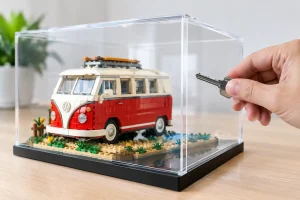
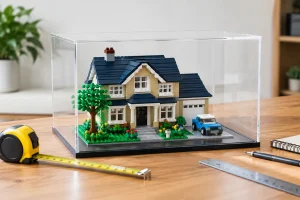
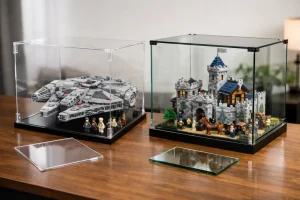
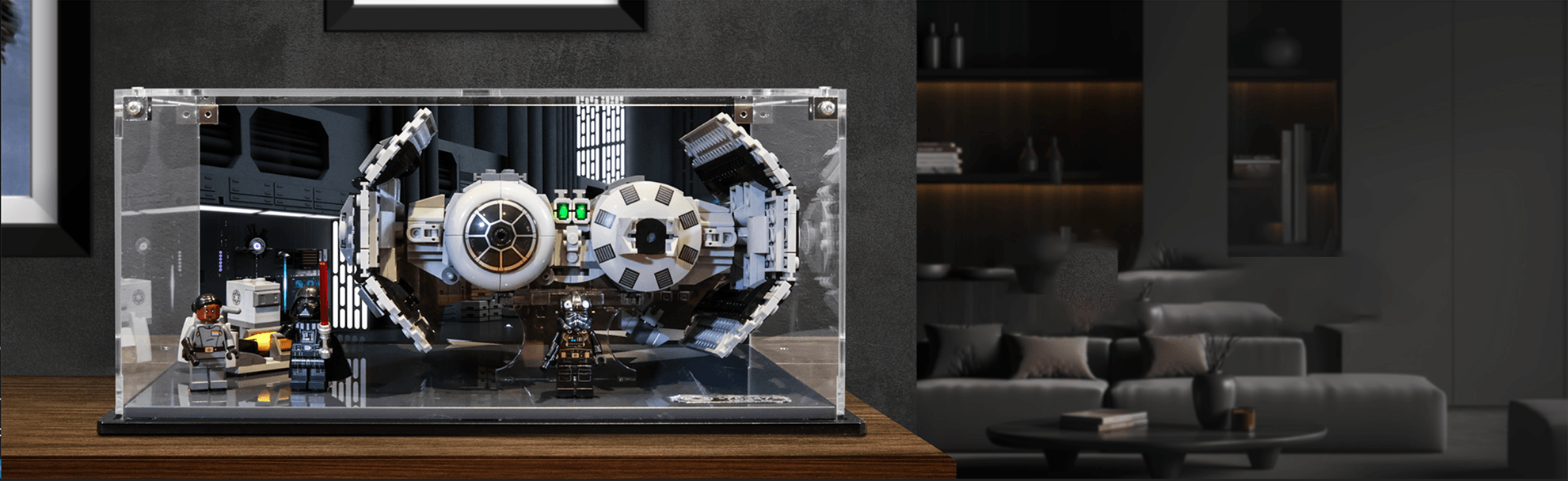
A purpose-built acrylic display case is particularly useful for premium, detailed or awkwardly shaped sets. Unlike a generic plastic tub, it lets the model remain part of the room while giving it a clear protective boundary. Set-specific cases also matter more than they may first appear. A correctly sized case gives a build enough breathing room without leaving it looking lost inside a huge empty box, and a fitted base helps prevent shifting.
Keep Dust Out Before It Becomes a Problem
Dust is not just a cosmetic nuisance. Once it has settled between studs, around stickers and inside textured elements, cleaning can mean partial disassembly or a very patient session with a soft brush. Models with exposed interiors, foliage, engines and minifigure scenes are especially vulnerable.
An enclosed case is the most reliable way to reduce dust buildup. It will not make a collection completely maintenance-free, particularly in a busy home, but it turns weekly cleaning into a much lighter and less frequent task. If cases are not practical for every set, use a closed glass-fronted cabinet for smaller builds and reserve open shelving for sturdy, easy-to-clean models.
Avoid placing built LEGO directly beneath air vents, extractor fans or frequently opened windows. Airflow carries dust quickly, and a kitchen-adjacent shelf can add grease to the mix. A clean, dry room away from cooking fumes is a far kinder environment for a prized build.
When cleaning an exposed model, use a soft make-up brush or a clean, anti-static detailing brush. Work gently from top to bottom and support any delicate sections with your other hand. Compressed air can seem tempting, but it can blast loose elements across the room, force dust further into gaps and leave condensation if used carelessly. It is rarely the collector-friendly option.
Protect LEGO From Sunlight, Heat and Moisture
Sunlight is one of the quietest risks in a display room. Over time, direct UV exposure can fade colours, particularly on white, light grey and brightly coloured pieces. It can also make a once-uniform display look patchy where one side has caught more light than the other.
Keep sets out of direct sun, even if they are inside a clear case. Position shelves away from south-facing windows where possible, use blinds or curtains during the brightest part of the day, or choose a room with softer natural light. A display case with UV-printed artwork can elevate the setting around a build, but the model itself still benefits from sensible placement.
Heat matters too. Do not display a large set above a radiator, beside a fireplace or in a conservatory that becomes hot in summer and cold in winter. Repeated temperature swings can stress connections and encourage warping in long, thin elements. The same goes for damp spaces such as garages, sheds, lofts and basements. Even if the bricks themselves look fine, moisture can damage cardboard boxes, instructions and labels, while changing humidity is not ideal for stickers or printed parts.
A stable indoor room is best. If you must store a model in a less-used area, aim for a dry, insulated space with minimal temperature variation.
Give Every Build Proper Support
Many display disasters begin with a shelf rather than the set. A large build can be surprisingly heavy, especially once it includes a dense base, display stand or multiple minifigures. Thin floating shelves, bowed bookcases and uneven surfaces are not worth the risk.
Choose a level, rigid shelf that is deeper and wider than the model or its case. The display should not overhang the edge, and there should be enough clearance around it that people can reach nearby items without brushing against wings, antennae or tall towers. For a heavy set, check the shelf brackets and stated weight capacity rather than assuming it will cope.
Long models need support across their full length. A starship displayed only at its centre can sag, flex or gradually loosen at connection points. Use the stand designed for the set, or a stable display base that supports the model where it needs it. Never improvise with a pile of books, loose bricks or an unstable acrylic riser.
If you are placing a case on furniture, use a clean, flat surface. Avoid soft mats that compress unevenly and make the base rock. A solid base gives the whole display a more premium look as well as a safer foundation.
Store Sets Temporarily Without Crushing Them
Sometimes a collection simply outgrows the display room. If a built model must be put away for a move, decorating project or future display space, do not drop it loose into a cardboard box and hope for the best. Loose models can snag, collapse under their own weight or become tangled with accessories.
First, photograph the build from several angles. These pictures are invaluable if a section comes apart later. Remove any loose accessories, minifigures, capes and delicate detachable sections, then place them in labelled bags or small containers. Keep those containers with the set, but not where they can slide around and strike it.
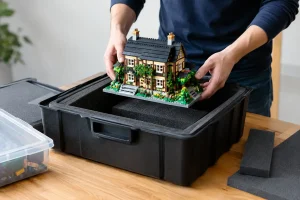
For larger builds, partial disassembly is often safer than trying to transport them whole. Separate the model at its natural modules: floors of a building, detachable wings, removable roofs, vehicle body sections or landscape plates. This is not defeat. It is practical collection care. Keep modules large enough to rebuild easily, but small enough that each one can be lifted without flexing.
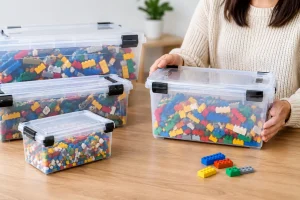
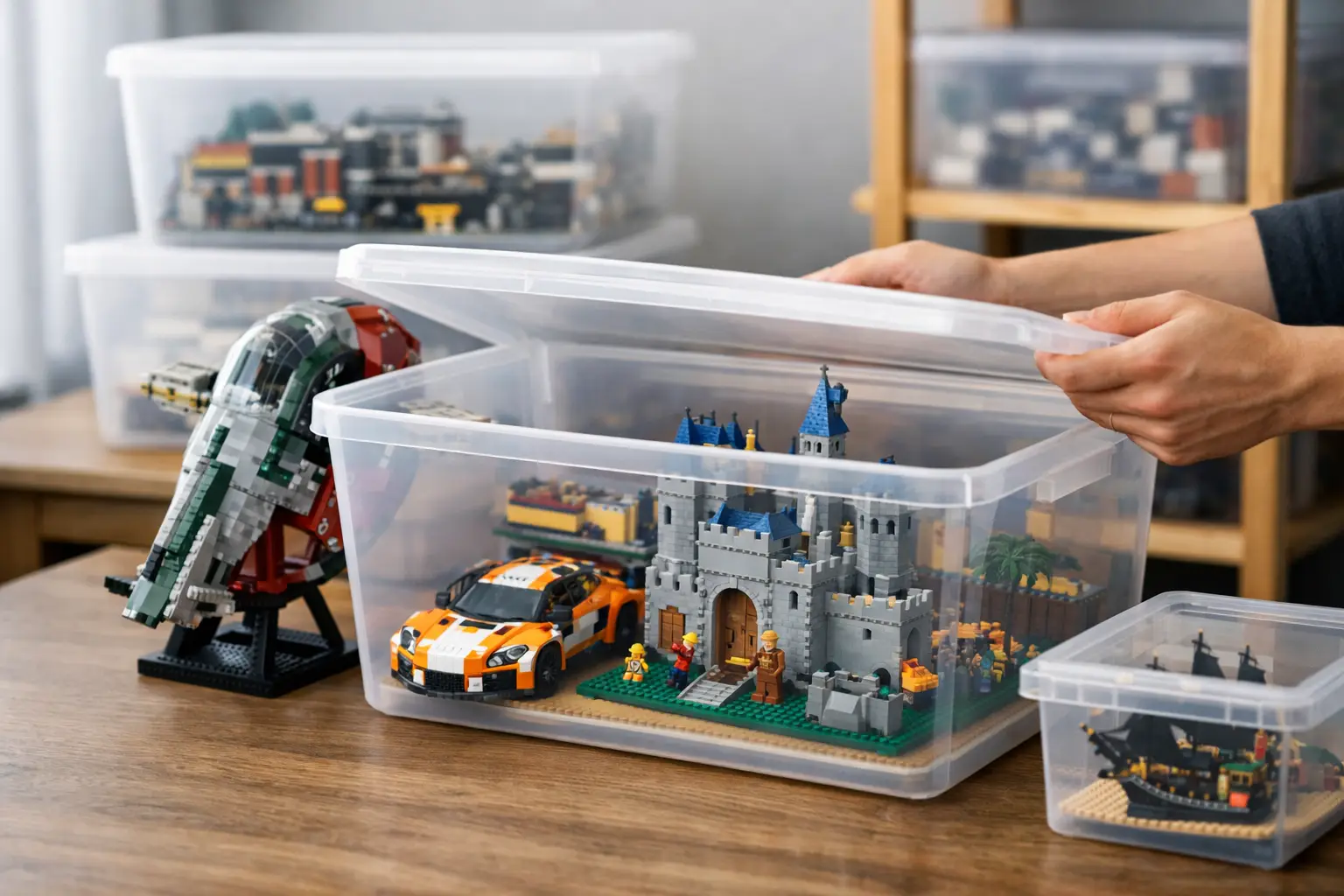
Wrap individual modules loosely in acid-free tissue or clean, soft packing paper, then place them in a sturdy plastic storage box. Use padding around the sides so pieces cannot move, but never pile heavy items on top. Avoid cling film directly against LEGO, as it can trap moisture and leave an unwanted residue over time.
Move Displayed LEGO Like a Collector
Moving house is where impressive models meet their toughest challenge. The safest option is usually to disassemble complex builds into logical sections before the move, especially anything with tall structures, unsupported wings or intricate landscaping.
For smaller, solid sets, carry them on a rigid tray or board rather than gripping the model itself. Hold the base with both hands and keep the route clear before you start. Car transport is safer than the boot of a van where possible, as temperature, vibration and stacked boxes are easier to control.
Do not rely on a display case as a transport crate unless it has specifically been designed and packed for that purpose. A case protects from dust and casual contact, not necessarily the jolts of a pothole or a hurried removal day.
Make Storage Part of the Display
The best storage solution should not make a collection feel hidden away. It should give each build the stage it earned. Grouping sets by theme, scale or colour creates a more intentional display, while printed bases and themed backgrounds can turn a favourite model into a proper centrepiece.
Brixbox display cases are designed around that collector mindset: set-specific presentation, clear protection and a finish that complements the story behind the build. For a landmark set, a well-fitted case can be the difference between simply owning it and truly showcasing it.
Before adding another model to a shelf, pause and look at the space as a whole. Give the build room, support and protection, then let it do what it was built to do: bring a little piece of your favourite world into the room.
RECENT POST