LEGO Blog
All the latest Brixbox news, straight from the team.

Can Display Bases Support Weight Safely at Home?
A detailed UCS starship, a sprawling Hogwarts scene or a Technic supercar deserves more than a shelf-space gamble. Can display bases support weight? In most cases, yes – but only when the base is designed for the model, assembled correctly and placed on a suitably strong surface. The real question is not whether a display base can carry a build for a few minutes. It is whether it can keep carrying it safely, levelly and beautifully for years.
For serious collectors, the base is part of the display rather than an afterthought. It frames the set, creates a clean foundation for printed artwork or a themed background, and helps turn an impressive build into a proper centrepiece. Get the specification right and your collection looks elevated. Get it wrong and even a premium case can be compromised by bowing, strain or an uneven shelf below it.
Can display bases support weight over time?
A well-made display base can support substantial weight, but capacity depends on several connected factors: the material, the thickness of the panels, the overall footprint, how the parts join together and how evenly the LEGO model’s weight is distributed. A compact helmet display and a large UCS-scale build place very different demands on a base, even if they appear similar at first glance.
Acrylic is popular because it delivers a crisp, gallery-style finish while being lighter than glass. It is also ideal for printed designs, allowing the scene beneath a model to add depth without competing with the build itself. However, acrylic is not magical. Like any rigid sheet material, it can flex if a heavy load is concentrated in a small area or if a large unsupported span is asked to do too much.
That is why set-specific display cases and bases matter. They are planned around the dimensions, stance and visual balance of a particular set rather than relying on a one-size-fits-all platform. A base designed for a long vehicle, for example, needs to account for where its wheels, landing gear or display stand transfer weight. A base for a wide building needs enough support across the entire footprint, not just around the outer edges.
The greatest risk is usually not dramatic collapse. It is gradual deflection: a slight dip, twist or gap that becomes more noticeable over time. For a collector who has spent hours placing every tile, minifigure and antenna, that is reason enough to choose the correct display solution from the start.
What determines how much weight a display base can hold?
The model’s footprint matters as much as its mass
Weight spread over a broad, flat footprint is easier for a base to support than the same weight concentrated on four narrow points. Think of a large LEGO building resting across a full baseplate compared with a spacecraft balanced on small landing feet. The first spreads its load naturally. The second sends most of its force into a handful of contact points.
This is particularly relevant for display stands. A stand may safely hold a model at an eye-catching angle, but the load is channelled through the stand’s connection points. The stand must be purpose-built for that model’s size and centre of gravity, and the base beneath it must remain stable under that concentrated force.
A model can also become heavier than expected once you add scene details, a printed base layer, lighting components or extra minifigures. Those additions are usually modest, but a display should always be selected for the complete presentation rather than the bare set alone.
Thickness and construction create stability
Panel thickness affects stiffness, especially across wider bases. A thicker acrylic base generally resists flexing more effectively than a thinner one, but thickness alone is not the whole story. The way panels are cut, seated and joined makes a meaningful difference to the finished structure.
A properly designed base uses accurate fit and secure connections so the load is transferred through the assembly rather than leaving one panel to carry all the pressure. If a base feels loose, rocks on a flat surface or has visible gaps after assembly, stop before placing the set inside. Recheck the orientation of every part and ensure the base is fully seated.
Premium display cases are also designed as a system. The base, clear panels and lid work together to protect the build from dust and casual knocks. The lid should never be treated as a load-bearing surface, though. Avoid placing other sets, books, storage boxes or even a hand for support on top of a case.
The surface underneath is part of the load calculation
The display base can be perfectly capable, while the shelf underneath is the weak point. Floating shelves, lightweight bookcases and long shelves without central support can sag under a growing collection. Add several large cases side by side and the combined load soon becomes far greater than it appears.
Before arranging your display, check that the furniture is level and rated for the intended weight. Keep the case fully supported rather than allowing an edge to overhang. A flat, stable surface is essential because an uneven shelf can place twisting forces on the base and cause a model to sit awkwardly inside the case.
Heat is another consideration. Avoid radiators, sunny windowsills and enclosed spaces that become very warm. High temperatures can affect acrylic over time, while direct sunlight may fade printed artwork and discolour LEGO elements. A cool, dry room with a solid cabinet or shelf gives a premium display the long-term conditions it deserves.
How to set up a heavier LEGO display safely
Assembly is the moment to prevent most problems. Work on a clean, flat table and remove protective film carefully, particularly from visible acrylic faces. Do not rush the process or force parts into place. Acrylic is beautifully clear and precise, but it should be handled with the same care you would give a prized build.
Place the base on its final display surface first, then check for any rocking before adding the model. It is far easier to correct a shelf issue when the case is empty. Once the base is stable, lower the set into position with two hands where possible, supporting the strongest points of the build rather than lifting it by delicate wings, towers or decorative sections.
If your model uses a stand, make sure it is properly engaged before stepping away. Give the display a visual check from the front and side. Does the model look level? Are all feet or stand points making the intended contact? Is any part of the build pressing into the case wall? A few seconds here can save a frustrating rebuild later.
For larger centrepieces, avoid dragging the completed case across a shelf. Lift it from the base with support underneath, ideally with a second person helping. Dragging can scratch the surface below, stress the joins or shift the model unexpectedly inside.
Signs that a base needs attention
A quality display should feel calm and secure, not like a balancing act. If you notice bowing across the centre, a new rocking movement, separating joints or a model leaning differently than before, remove the build carefully and investigate. The cause may be an overloaded base, but it could also be an uneven shelf, a missed assembly step or a change in the model’s contact points after moving it.
Never try to compensate for a sagging or unstable base by wedging random objects beneath one corner. That can create a new pressure point and make the issue worse. Instead, move the display to a genuinely level surface and use a base or case matched to the exact model and its display configuration.
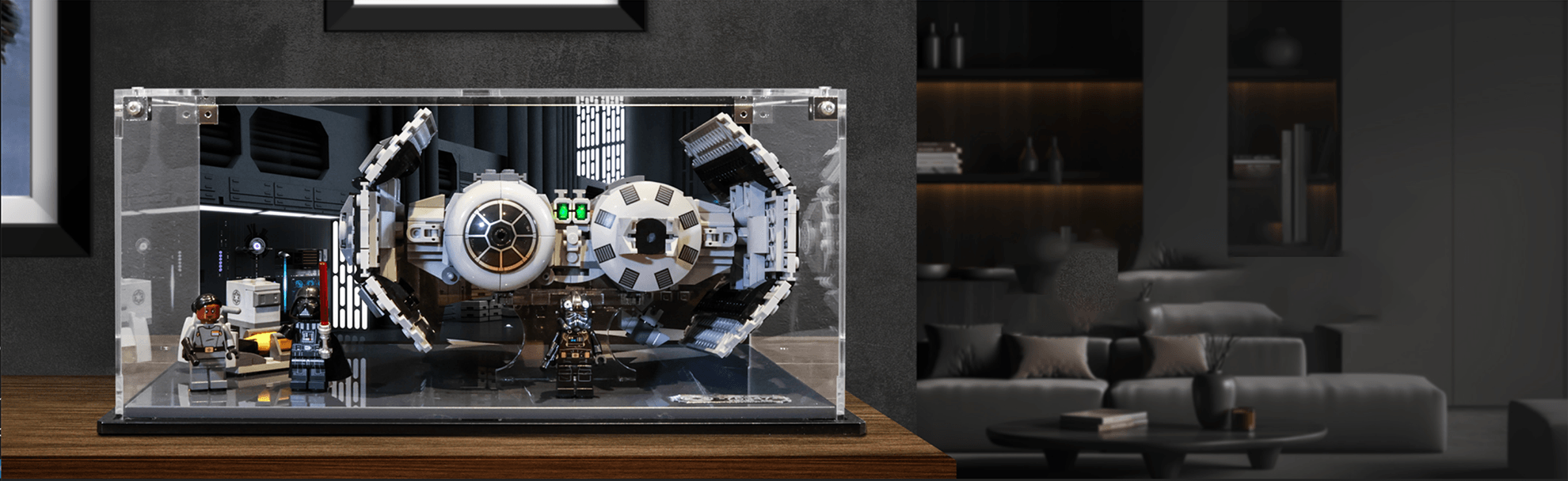
When choosing a display solution from Brixbox, look beyond the external dimensions. Consider the set number, whether the build sits flat or on a stand, the room needed around delicate details and the kind of visual finish you want. A themed UV-printed base is not simply decoration – it can give a set its own stage while a correctly fitted case keeps the whole scene protected.
Your collection is built brick by brick, often over many happy hours. Give every flagship model a foundation worthy of the story it tells: properly supported, dust-protected and ready to steal the scene every time you walk past.
RECENT POST