LEGO Blog
All the latest Brixbox news, straight from the team.
LEGO Collector Display Planning That Works
That newly completed UCS starship, Hogwarts landmark or Technic supercar deserves more than the nearest spare shelf. LEGO collector display planning is the point where a brilliant build becomes part of your home: protected from dust, framed for its best angle and given enough room to be properly appreciated.
The difference is immediately visible. A collection arranged set by set can feel crowded, even when every model is impressive. A collection planned around scale, sightlines, themes and protection feels intentional. It turns a room, office or dedicated hobby space into a showcase with stories to tell.
Start LEGO collector display planning before the next build
The best time to plan a display is before a large box arrives, not when you are trying to squeeze a finished model between two others. Check the assembled dimensions rather than judging by the size of the packaging. Length, depth and height matter, but so do antennas, raised wings, opening panels and the space needed to view the model from its strongest side.
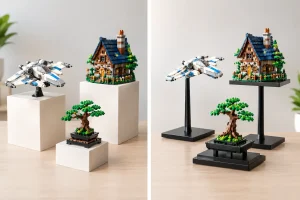
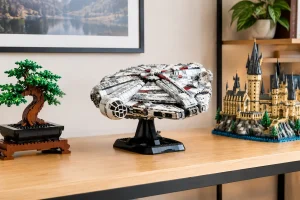
Give each major build a realistic footprint. A Millennium Falcon, large Hogwarts display, modular building or 1:8 scale Technic car can dominate a shelf quickly. Leave breathing room around it rather than lining models up edge to edge. That negative space is not wasted capacity. It lets the silhouette read clearly and makes a premium set feel like the centrepiece it is.
Also consider access. If a set needs to be moved every time you want a book, a controller or a board game, it will be handled more often than it should be. A display should protect the build from everyday life, not place it directly in the path of it.
Choose the display story first
A great collection rarely needs every theme displayed in one place. Grouping by story, location or visual style gives your shelves much more impact. Star Wars collectors might build a galactic scene with a flagship model as the focal point, helmets or BrickHeadz providing scale around it, and a small minifigure display adding character. A Harry Potter arrangement can move from iconic locations to magical vehicles and smaller characters without feeling like a random row of boxes.
There is no single right approach. Theme-led displays create immersion, while type-led displays can look exceptionally clean. A shelf of helmets has a strong, gallery-like rhythm. A row of Technic cars celebrates engineering and makes it easier to compare forms, colours and functions. If your collection spans multiple fandoms, separate them by shelf or cabinet level rather than forcing competing worlds into the same scene.
Think in focal points. One large set usually leads the eye, with two or three supporting pieces around it. Trying to make every model the star can make even a generous display area feel noisy. Your favourite build should have the strongest position, usually at eye level or slightly below it where details are easiest to enjoy.
Build around sightlines, not just shelf measurements
A display viewed mostly while standing needs a different plan from one beside a sofa or desk. Tall sets placed high can become a collection of roofs and upper surfaces. Low shelves can hide the best details of a vehicle behind the shelf above. Before committing, stand where you will normally see the display and imagine the key angles.
This is especially useful for models with a clear front, such as vehicles, helmets, dioramas and character builds. Position the strongest face towards the room. For models designed to be admired from several sides, such as large spacecraft or detailed modular buildings, allow a little clearance behind and beside the case so the model can still be viewed properly.
Plan protection as part of the presentation
Dust is not merely a cleaning issue. It softens the sharp finish of light elements, catches around greebling and can turn the careful detail of a prized build into a maintenance job. Open shelving works for a small, rotating selection, but permanent displays benefit from more considered protection.
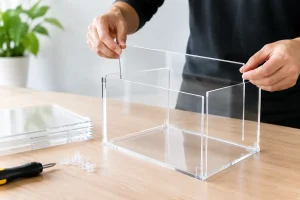
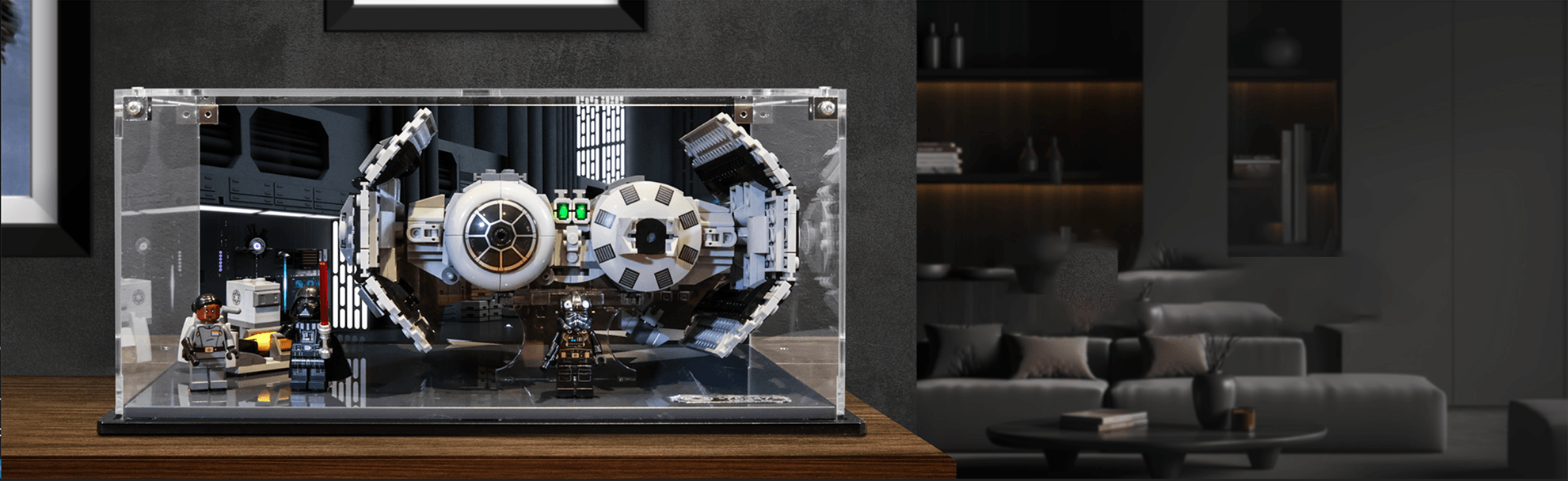
A set-specific acrylic display case gives a build its own defined space. It helps shield the model from dust and casual knocks while retaining the clear view that makes brick-built models so satisfying to inspect. Unlike a generic box, a case designed around a particular set can account for the model’s footprint and allow its proportions to remain the focus.
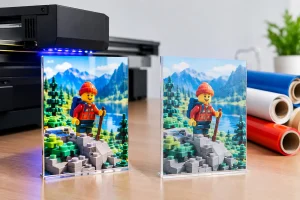
The base is equally important. A printed base can ground a vehicle, diorama or landmark visually, while a UV-printed background can add atmosphere without filling the shelf with extra loose elements. The right artwork should support the model rather than overpower it. A dark space backdrop can make a Star Wars ship feel cinematic; a clean architectural scene can give a modular building more presence. For a highly detailed set with bold colours, a simpler backdrop may be the stronger choice.
At Brixbox, set-specific cases and themed printed elements are designed for exactly this balance: protection with a presentation that feels worthy of the build.
Light carefully and avoid heat
Lighting can transform a collection, especially in a darker room, but it needs restraint. A soft LED strip above a shelf can reveal texture and depth without creating harsh reflections on acrylic. Avoid placing lights where individual points glare directly into the viewing angle, and keep cables hidden where possible.
Direct sunlight is the bigger concern. Strong sun can make a display difficult to see through and may affect colours over long periods. Choose an interior wall or position the display away from the brightest part of the window. If sunlight cannot be avoided, treat that area as a place for less colour-sensitive or frequently rotated models rather than your rarest long-term centrepiece.
Design for growth without displaying everything
Most collections do not stop at one shelf. Planning for growth saves you from rebuilding the whole arrangement every time a new release earns a place. Reserve a little room in each theme, or create a rotation shelf where recent builds can enjoy their moment before moving into long-term storage or another display zone.
Not every completed set needs to remain on show forever. This is not a failure of the collection. Rotation protects against visual overload and helps you reconnect with models that have been overlooked. Seasonal displays can work particularly well: a winter village at the right time of year, a new Star Wars build around a film or series release, or a motorsport shelf refreshed when the racing calendar returns.
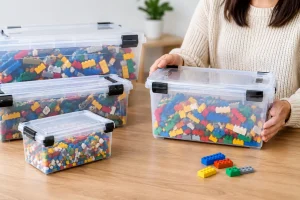
Storage should support the display plan too. Keep instruction manuals, spare elements and carefully dismantled sets organised and clearly labelled. That makes rotation feel enjoyable rather than like a weekend spent searching through mixed parts. For sets you may rebuild, retaining bags by build stage or using compartmented storage can save considerable frustration later.
Make the room work for the collection
A display does not need a dedicated LEGO room to look exceptional. A single cabinet in a living room, a well-planned office shelf or a protected sideboard can create a striking collector space. What matters is consistency. Repeating a limited palette of cases, bases or shelf finishes helps models from different themes feel curated together.
Be honest about the practical limits of the room. A high-traffic hallway, a shelf above a radiator or a narrow ledge next to a door may be available, but it is rarely ideal for a delicate, expensive build. Weight is another consideration. Large models, cases and solid shelving add up, so use furniture and wall fixings that are genuinely suitable for the load.
Small details carry real weight. Straighten minifigures, align labels, remove loose packaging from view and clean acrylic with an appropriate soft cloth. These are simple finishing touches, but they preserve the crisp, considered look that turns a group of sets into a display.
Your collection should feel exciting every time you walk past it. Give the build room, give the story a setting, and let each finished model take its place as more than the end of a project.
RECENT POST