LEGO Blog
All the latest Brixbox news, straight from the team.
Best Cases for LEGO Cars: A Collector’s Guide
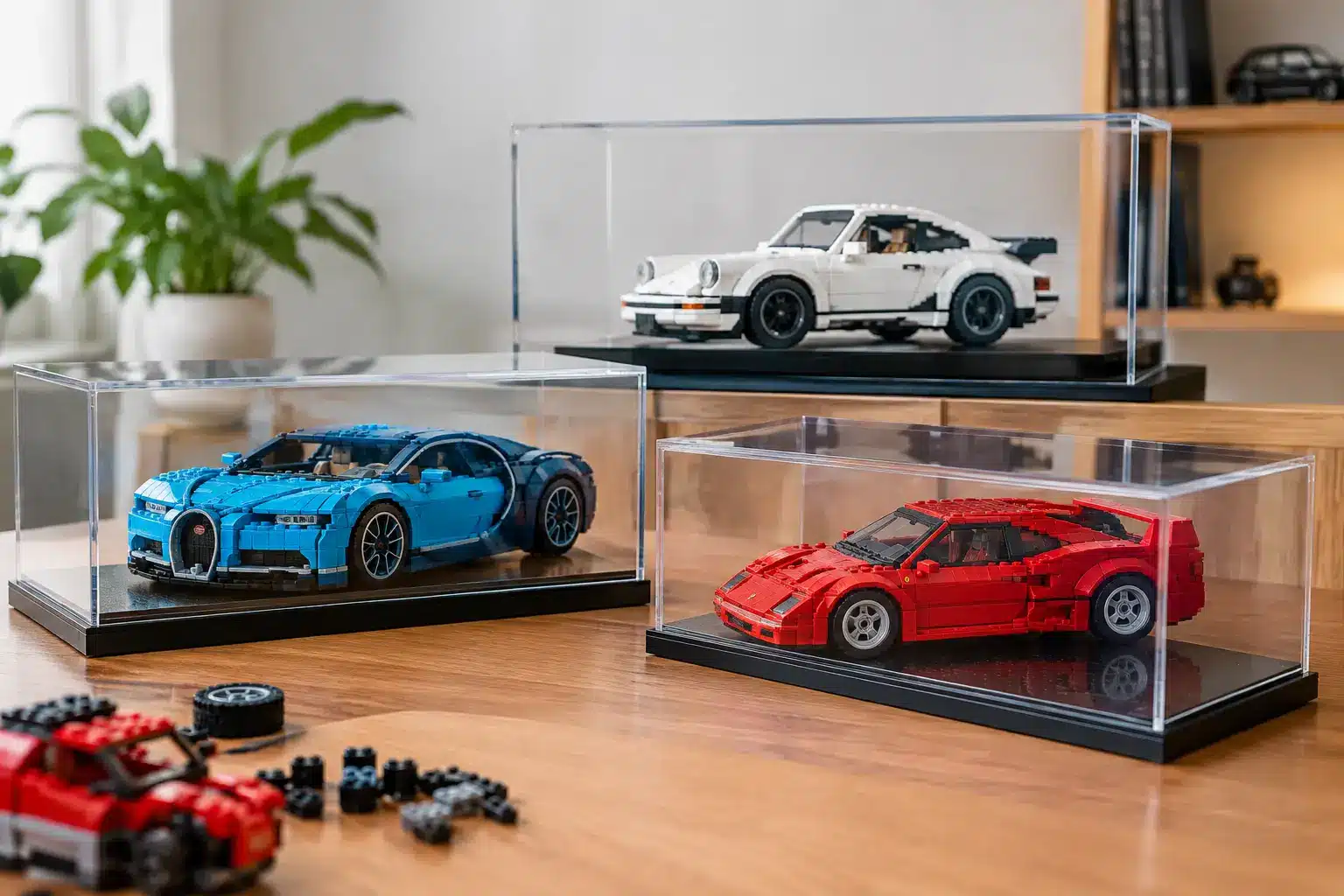
A finished LEGO car should not spend its life fighting dust on an open shelf. Whether it is a low-slung Speed Champions racer, a detailed Icons classic or a flagship Technic supercar, the right display case protects the small details you spent hours building – and gives the model the presence it deserves.
The best cases for LEGO cars do more than put clear acrylic around a set. They give the build room to breathe, create a cleaner backdrop for its lines and livery, and make a collection look deliberately curated rather than simply stored. The crucial choice is not just which case looks good, but which one is designed around the scale, shape and story of your car.
Why LEGO car sets need purpose-built cases
Cars are among the most display-sensitive LEGO builds. Their appeal often lies in precise proportions: a sweeping rear wing, a shallow windscreen, a wide stance, exposed engine detail or a carefully recreated grille. On a crowded shelf, those features disappear. Dust settles particularly quickly in wheel arches, around spoilers and across transparent elements, turning a showpiece into another item that needs regular cleaning.
A fitted acrylic display case provides a physical barrier against dust, accidental knocks and curious hands. It also changes how the model reads in a room. Clear panels keep the focus on the build, while a printed base or themed background can supply the track, garage, road or racing atmosphere the set itself hints at.
That said, a case is not automatically the answer for every vehicle. If you rebuild often, pose a model for photography every week or need to access working Technic functions regularly, an open display stand may suit you better. A case makes most sense when a build is finished, valued and ready to become part of the collection.
Best cases for LEGO cars by collection type
The ideal case depends on more than the set’s length. Height, moving parts, display angle and the space around the model all matter. A compact car in an oversized box can look lost, while a tight-fitting case can make a large model feel cramped and awkward to handle.
Speed Champions: compact cases with maximum impact
Speed Champions models may be small, but they are packed with decals, printed elements and recognisable design cues. A purpose-built case for a single car is a brilliant way to turn one favourite build into a desk display, especially where shelf space is limited.
Look for a case with enough clearance around the front splitter, mirrors and rear wing. A printed base can make a huge difference at this scale, giving the car a sense of movement without adding physical clutter around it. If you collect several models from the same motorsport era or manufacturer, matching cases create a sharp, gallery-style line-up.
For multi-car sets, choose a case designed for the full build rather than trying to squeeze the cars into separate spaces. Supporting scenery, pit-lane details and minifigures often complete the story and deserve to be displayed too.
LEGO Icons vehicles: room for iconic silhouettes
LEGO Icons cars tend to reward closer viewing. They may have opening doors, detailed interiors, spare wheels, chrome-style elements or classic colour schemes that deserve a more refined presentation. The best approach is usually a case that frames the car with modest, even clearance on all sides.
Too much unused acrylic can flatten the visual effect. A carefully sized case makes the vehicle feel like a museum exhibit, drawing attention to the distinctive shape rather than the empty space around it. For vintage-inspired builds, a printed base with understated road, showroom or workshop styling can complement the car without competing with it.
Check the model’s highest point before ordering. Raised roof accessories, aerials and opening bonnets can make the practical height different from the basic dimensions listed for the build.
Technic supercars: large cases for serious centrepieces
A flagship Technic car is rarely a background piece. These are substantial builds with working suspension, steering, gearboxes and bodywork that invite people to look closer. They need a case with generous internal dimensions, a stable base and enough visual presence to match the scale of the model.
For these sets, the base matters as much as the cover. A strong printed base anchors a heavy model and gives it a finished display footprint. It also makes a car feel intentionally positioned, rather than placed on a bare shelf. Motorsport-inspired graphics, carbon-fibre-style textures or a clean showroom setting can enhance the model’s character, but restraint counts. The car should remain the headline act.
Consider access before you commit. If you enjoy demonstrating the suspension or opening panels for visitors, select a case format that can be lifted away cleanly and returned without disturbing the build. The more complex the model, the more valuable easy access becomes.
Formula 1 and racing cars: make the livery work harder
Racing models have a visual advantage: bold colours, sponsor-inspired graphics and aerodynamic bodywork naturally command attention. They also have a common display problem. Delicate wings, narrow tyres and exposed suspension can make them vulnerable when placed in busy areas of the home.
A case protects those fragile details while allowing the livery to stay fully visible from every angle. For a single Formula 1 car, choose a proportion that follows the vehicle’s long, low profile. For a grid of cars, consistency is key. Identical case styles and coordinated bases can turn individual builds into a proper motorsport display rather than a row of unrelated models.
What to check before choosing a case
Set-specific compatibility is the simplest route to a polished result. A case made for the exact set number accounts for the car’s true footprint, including details that are easily missed when measuring by hand. It also avoids the familiar collector frustration of receiving a case that is technically large enough but visually wrong.
If you are choosing by dimensions, measure the completed model at its widest, longest and tallest points, then allow sensible clearance. Do not forget extended mirrors, spoilers, antennae, doors or raised bonnets. Measure the display location as carefully as the set itself. A spectacular case is no use if it blocks a cupboard door or overhangs a narrow shelf.
Acrylic clarity and construction deserve attention too. Premium clear panels should showcase the model without distracting joins or a cloudy appearance. A secure, well-made base keeps the display looking squared away, particularly with larger Technic sets. Keep the case away from direct, prolonged sunlight where possible, as strong light can be unkind to colours and printed elements over time.
Make the case part of the display
The strongest LEGO car displays feel complete before anyone notices the case. That is where custom printed bases and backgrounds earn their place. They create context: a grand touring car can sit in a refined showroom setting, a rally-inspired build can gain a dramatic stage, and a track car can look ready for the starting lights.
The trade-off is personal taste. A heavily themed design can be thrilling for one treasured set but may feel limiting if you rearrange your display frequently. Clean printed bases offer flexibility, while dramatic backgrounds are ideal when you want one model to become a true focal point.
At Brixbox, set-specific cases and themed display options are designed for collectors who want that finished, exhibition-quality look without compromising on protection. The result should feel like a natural extension of the build, not an afterthought bought to contain it.
A better way to plan a growing car collection
It is tempting to case only the biggest or most expensive model first. There is nothing wrong with that, but visual impact often comes from planning a display in groups. One case for a Technic flagship can anchor a room, while a matching run of smaller cases can bring order to a Speed Champions collection on the shelf beside it.
Think about viewing height as well. Low cases work beautifully on a desk or eye-level shelf, where you can appreciate the roofline and interior. Larger cars benefit from a position where you can see their front three-quarter angle, wheel design and cockpit without looking down on them from too high.
Choose the case that makes you pause when you walk past. A great LEGO car display does not merely keep dust away. It preserves the finished build, celebrates every detail and gives your collection the stage it has earned.
RECENT POST