LEGO Blog
All the latest Brixbox news, straight from the team.

UCS Display Case Example: Display the Falcon
A UCS display case example is most useful when it solves the problem every big build eventually creates: where can something this spectacular live without becoming a dust magnet, a handling risk, or an awkward fit on a shelf? Take the LEGO Star Wars Millennium Falcon UCS set. It is not simply a model to put away after the final brick is placed. It is a centrepiece with a huge footprint, thousands of carefully aligned details, and a silhouette that deserves room to command attention.
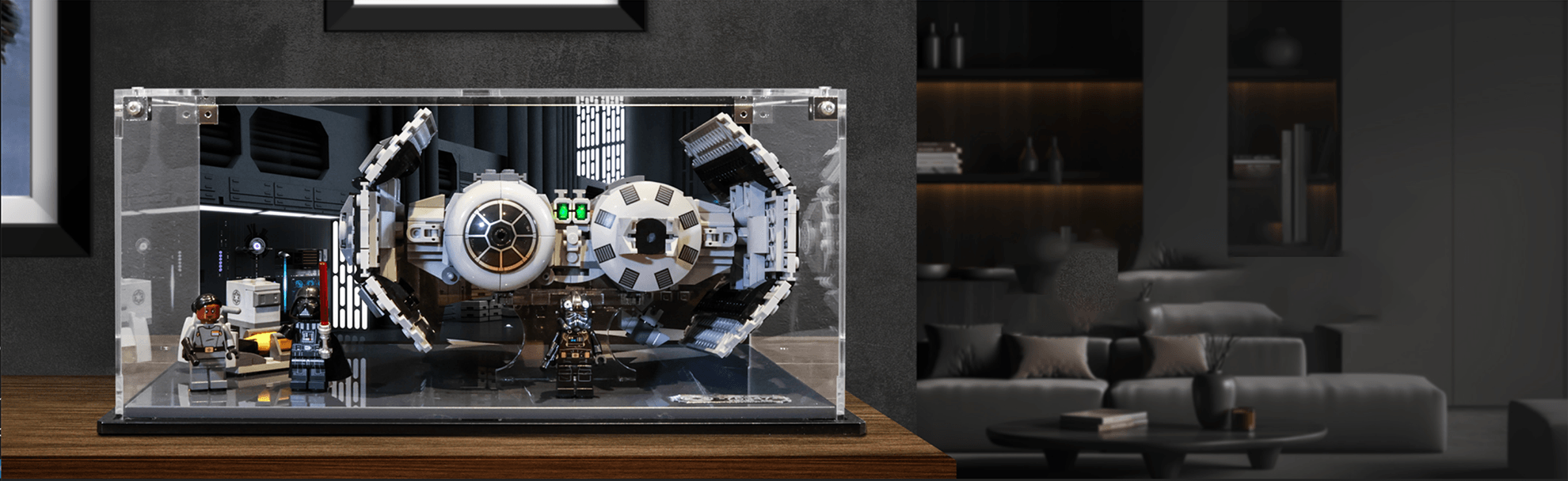
A purpose-built acrylic case turns that finished build into a proper exhibit. Rather than placing the Falcon on a bare shelf and hoping nobody catches a radar dish or landing gear while dusting, the case creates a clean visual boundary around it. Add a printed base and themed UV-printed background, and the display starts to feel less like storage and more like a scene from the galaxy far, far away.
UCS display case example: the Millennium Falcon
The Millennium Falcon is an ideal UCS display case example because its scale makes generic display solutions a poor compromise. A standard cabinet may be too shallow, a glass shelf may leave the model exposed on every side, and a clear box with no considered base can make even an extraordinary build look disconnected from the room around it.
A set-specific case is measured around the model’s true dimensions, including the widest points of the dish, cockpit and engine section. That matters. The Falcon needs breathing room, but not so much unused space that it loses visual impact or looks like it is floating in an oversized cube. A close, precise fit frames the build while leaving enough clearance to protect its delicate edges.
The best presentation also considers the viewing angle. Most collectors display the Falcon front-on or at a slight angle, where the cockpit, mandibles and circular rear profile are immediately recognisable. A printed base can establish a darker, more dramatic foundation beneath the light grey build, while a themed backdrop gives the model depth without competing with its intricate surface detail. The case remains clear where it should be clear, allowing the LEGO craftsmanship to do the talking.
This is where a display case earns its place. The build stays visible from the room, protected from the day-to-day dust that settles into exposed studs, vents and greebling. It also creates a safer home for a model that is difficult to move, time-consuming to clean and far too impressive to hide in a cupboard.
What makes a UCS case feel collector-worthy?
For premium Ultimate Collector Series builds, protection is only half the brief. The other half is presentation. A case should make a set look intentional in a home office, cinema room, gaming space or living area – not like it has been temporarily parked on furniture.
The fit should follow the set, not the other way round
A generic case asks the collector to work around its dimensions. A set-specific case is designed around the build itself. That means the model has appropriate clearance, the base supports the intended footprint, and the overall proportions look balanced from the front and sides.
This becomes especially valuable with UCS sets that have fragile protrusions, wide wings or uneven shapes. The X-wing, Razor Crest, AT-AT and Venator each need a different approach. What works beautifully for the low, broad Falcon will not automatically suit a tall walker or a capital ship with a long, narrow profile.
Acrylic protection should not hide the model
Collectors choose acrylic cases because they preserve the view. Clear panels keep dust, casual handling and household mishaps at a distance while allowing the build’s brickwork, minifigures and small details to remain part of the room.
There is a practical trade-off here. A fully enclosed case needs occasional cleaning too, and acrylic should be treated with care to avoid scratches. But that is a far simpler job than cleaning years of dust from exposed LEGO elements, especially on a model with thousands of tiny gaps and layered components.
The base and background create the atmosphere
A great UCS display does not need visual clutter. It needs a setting that supports the model. A printed base can ground a ship in a hangar-inspired environment, a starfield or a technical display style. A UV-printed background can add cinematic depth, colour and theme without forcing the collector to build an entire diorama around the set.
For the Millennium Falcon, the choice depends on the feel you want. A dark, space-led backdrop gives the ship a dramatic museum-style presence. A brighter technical design can highlight the model’s engineering and make the case feel like a collector’s edition display. Neither is universally better. The right option is the one that works with your room, lighting and wider Star Wars collection.
Planning your own UCS display
Before choosing a case, decide whether the set will be the star of one shelf or part of a larger line-up. A single flagship build can handle a bold printed background and strong visual contrast. If you plan to place several UCS models together, a more consistent presentation may be the smarter choice. Matching case heights, base finishes and backdrop styles can make a collection feel curated rather than crowded.
Measure the available furniture space as carefully as you consider the set dimensions. A case protects the model, but it cannot fix a shelf that is too shallow or a cabinet that leaves no access for lifting the case on and off. Remember to account for the case itself, not only the LEGO set inside it. The finished display needs a stable, level surface and enough room above it for safe placement.
Lighting deserves attention as well. Strong direct sunlight can be harsh on any displayed collectible over time, while intense spotlights can create reflections across clear panels. Soft ambient lighting or carefully positioned LEDs usually give a better result, making the model visible without turning the acrylic into a mirror. If the display includes UV-printed artwork, balanced lighting helps the scene feel rich without overpowering the bricks.
A case is especially valuable after the build is finished
The final stage of a UCS build is often the point where collectors realise the job is not quite done. Building delivers the satisfaction of the process, but displaying preserves that achievement. It gives the set a permanent place and reduces the temptation to relocate it every time a shelf needs cleaning or a room needs rearranging.
That is particularly true for models built over several evenings, received as milestone gifts or saved for after a long-awaited release day. Their value is not only financial. They carry time, memory and the enjoyment of completing something remarkable. A carefully fitted display case respects all of that.
Brixbox cases are made for collectors who want that finishing touch to look as considered as the build itself. The goal is not to put LEGO behind plastic for the sake of it. It is to showcase the model with the scale, protection and themed presentation it has earned.
Whether your Falcon is the first UCS set in your collection or the flagship among many, give it a display that makes you stop and look every time you walk past. That is the real test of a great case.
RECENT POST