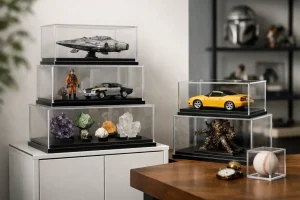
LEGO Blog
All the latest Brixbox news, straight from the team.
Acrylic Versus Polycarbonate Cases: Which Is Best?
A freshly completed LEGO set deserves better than a quick dusting before it joins an already crowded shelf. When choosing between acrylic versus polycarbonate cases, the right answer is not simply whichever plastic sounds tougher. For display-conscious collectors, the material affects how clearly a build is seen, how the case ages, how it handles everyday life and, crucially, whether the finished model still feels like the centrepiece it should be.
For most collector displays, acrylic delivers the polished, gallery-style presentation people want. Polycarbonate has serious strengths too, especially where impact resistance is the priority. The best choice comes down to what you are displaying, where it will live and how much handling the case is likely to receive.
Acrylic versus polycarbonate cases at a glance
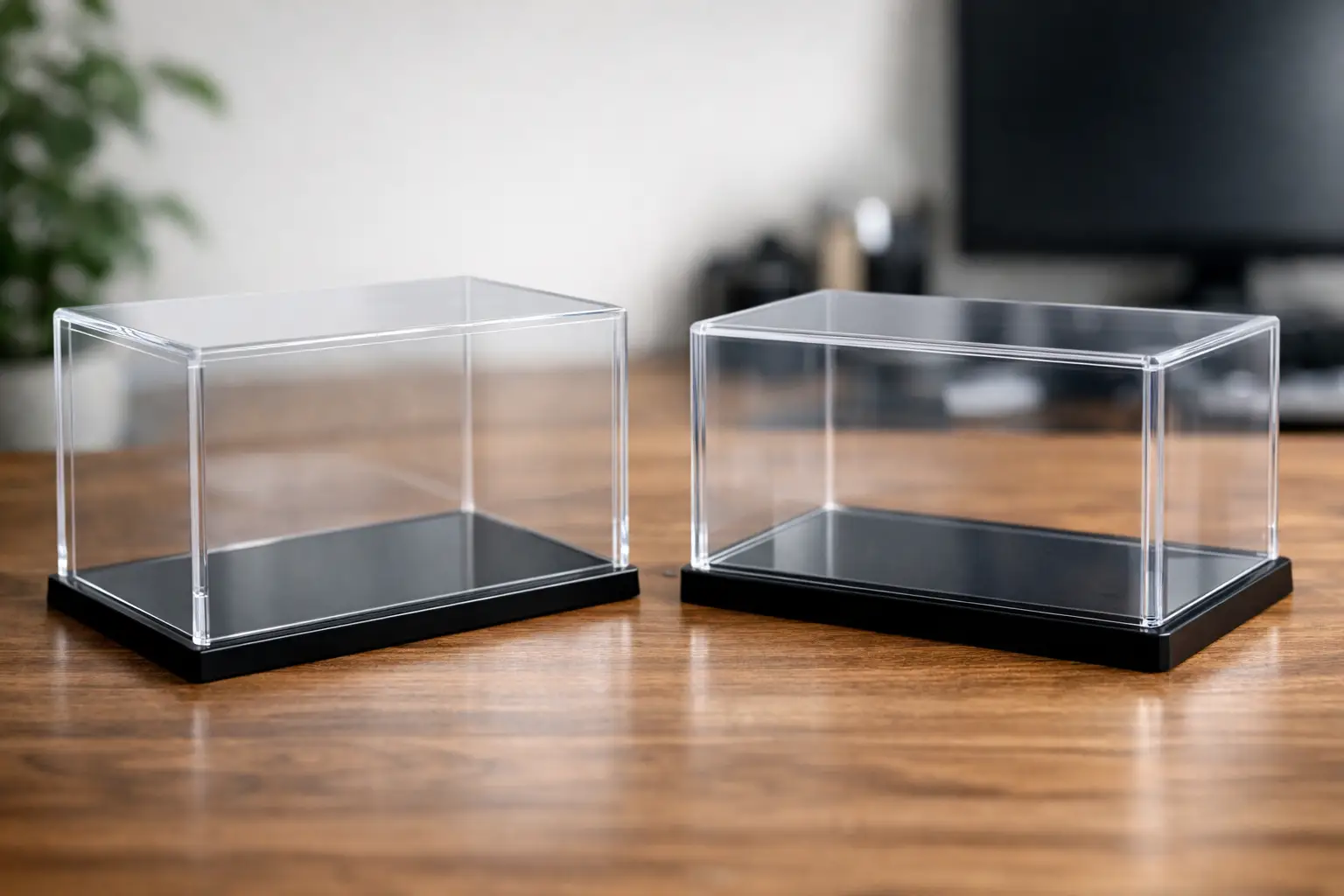
Acrylic and polycarbonate are both clear engineering plastics, but they behave very differently. Acrylic – often called PMMA – is known for its bright, crisp transparency and rigid feel. It is a favourite for premium display cases because it lets the colours, printed elements and fine details of a build take centre stage.
Polycarbonate is built for impact resistance. It is far less likely to crack if knocked or dropped, which is why it is used in applications where safety glazing matters. That toughness comes with a trade-off: polycarbonate is generally softer at the surface, so it can pick up scratches more readily and may not offer the same glass-like visual finish as quality acrylic.
Neither material is automatically better in every situation. A case for a carefully positioned UCS Star Wars model in a home office has different demands from a display in a busy family room, retail environment or event space.
Why acrylic is the display collector’s favourite
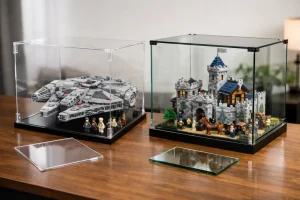
A great display case should not distract from the set inside it. Acrylic is exceptionally clear, helping transparent cockpit pieces, minifigure details, intricate greebling and carefully arranged scenes remain sharp from every angle. On a large build, that clarity makes a real difference. A Millennium Falcon, Hogwarts Castle or Technic supercar should look intentional and finished, not as though it is sitting behind cloudy packaging.
Acrylic is also naturally rigid. When panels are accurately cut and assembled, the result feels clean and substantial without becoming excessively heavy. That makes it well suited to purpose-built cases designed around a particular set’s footprint, height and viewing angles.
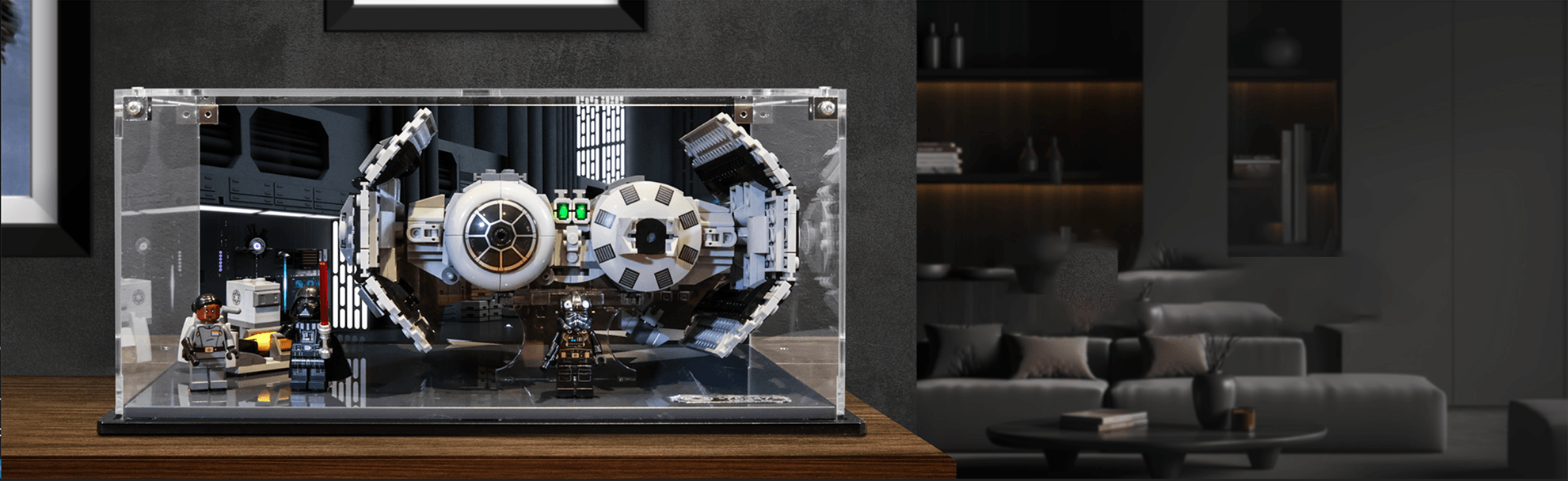
For themed displays, acrylic works especially well with printed bases and UV-printed backdrops. The case stays visually quiet while the background provides the atmosphere – a hangar bay for a Star Wars ship, a magical setting for a Harry Potter build or a track-inspired scene behind a Technic car. The model remains protected, but the presentation becomes part of the collecting experience.
The acrylic trade-off: surface scratches and impact
Acrylic is not indestructible. It can scratch if cleaned with a rough cloth, moved against abrasive surfaces or stored without care. It is also more brittle than polycarbonate, meaning a hard fall or sharp impact can cause cracking.
That sounds alarming, but context matters. Most premium LEGO displays are placed on a shelf, cabinet, desk or dedicated display unit and are not repeatedly moved about. In that setting, acrylic’s excellent presentation usually outweighs its lower impact resistance. Careful assembly and gentle cleaning go a long way towards keeping it looking superb.
Where polycarbonate earns its place
Polycarbonate is the material to consider when accidental impact is the biggest concern. It has an impressive ability to flex and absorb force rather than fracture. If a case will be used in a high-traffic public setting, transported regularly, displayed close to energetic pets or younger children, or handled frequently at exhibitions, that resilience can be valuable.
It can also be a practical choice for very large protective enclosures where the chance of a knock is greater. A collector who moves displays between rooms or takes models to club events may reasonably put durability ahead of the finest possible optical finish.
However, impact resistance is not the same as better protection in every sense. Polycarbonate can scratch more easily in normal use, and those fine marks may become noticeable under display lighting. Over time, a scuffed panel can take attention away from the build just as surely as dust can. Some polycarbonate products use hard coatings to improve scratch resistance, but quality and performance vary, so it is worth checking the exact specification rather than assuming all panels perform alike.
Clarity matters more than it first appears
A case may be clear, but not all clear materials create the same visual result. Acrylic has a crisp, polished appearance that suits collectors who want their display to look considered from across the room as well as up close. This matters most for sets with layered detail, dark colour schemes or bright internal lighting, where a duller surface can flatten the effect.
Polycarbonate remains transparent, but it can show a slightly different visual character and is more prone to micro-scratches over time. That does not make it unsuitable for displaying LEGO. It simply means it is often chosen for resilience first and presentation second.
If you have invested hours building a detailed scene, adding minifigures in just the right positions and selecting a location with good lighting, optical clarity should sit high on your checklist. The case is there to protect the view, not compromise it.
Dust protection depends on design, not material alone
It is easy to focus only on acrylic or polycarbonate, but the construction of the case has just as much influence on day-to-day protection. A well-designed case should cover the model properly, fit its intended footprint and minimise open gaps where dust can settle inside.
A generic box can leave a large model looking cramped, create awkward unused space or fail to accommodate raised wings, antennas, display stands and carefully posed figures. Set-specific sizing gives a completed build room to breathe while maintaining a tidy, tailored finish.
For collectors, that means fewer delicate cleaning sessions. Dust is not merely untidy on a shelf. It settles between studs, around stickers, inside cockpits and on hard-to-reach details that are frustrating to clean without disturbing the model. A fitted case lets you spend more time enjoying the build and less time carefully working a soft brush around it.
UV protection needs a closer look
Collectors often ask whether clear cases prevent fading. The answer depends on the exact material, grade and exposure. Some acrylic sheets offer useful UV-filtering properties, while others are designed primarily for clarity. Polycarbonate can also include UV protection, particularly in specialist grades or coated sheets.
A case should never be treated as permission to place a treasured set in direct, prolonged sunlight. Sunlight can affect LEGO elements, printed pieces, stickers and display artwork over time, while heat can create problems of its own. The strongest approach is to position displays away from direct sun and choose a case material with appropriate UV performance where exposure cannot be avoided.
For a display that includes a printed backdrop or base, protection is about the entire presentation, not just the bricks. Ask what material and print method are being used, especially if the case will sit near a bright window.
Cleaning acrylic and polycarbonate safely
Both materials reward a gentle approach. Use a clean microfibre cloth and avoid paper towels, kitchen roll, abrasive pads and harsh household cleaners. These can leave fine scratches or cause surface damage, particularly on polycarbonate.
For light dust, a soft anti-static cloth is usually enough. For marks, use a cleaner confirmed as safe for the specific plastic and wipe with minimal pressure. Never spray a cleaner directly over an assembled display containing your model. Apply it to the cloth first, then clean the outer panel carefully.
The simplest habit is also the most effective: keep the case in place and avoid unnecessary handling. A display that is not constantly lifted, shifted and polished will retain its finish for far longer.
Which case should you choose for your collection?
Choose acrylic when visual presentation, high clarity, rigidity and a premium display finish are your priorities. It is the natural fit for collectors building a permanent showcase around major LEGO sets, themed scenes, helmets, vehicles, modular buildings and prized minifigure displays.
Choose polycarbonate when the case faces a meaningful risk of knocks, falls or frequent transport. It is a practical material for demanding environments where its impact resistance is more valuable than a pristine, glass-like surface.
For most home collections, acrylic is the stronger all-round display choice. It gives completed builds the clean, elevated setting they deserve, particularly when paired with a set-specific base and artwork that celebrates the theme rather than hiding it. Brixbox acrylic cases are designed with that collector-first balance in mind: protect the build, frame the story and let every detail stand out.
Your collection does not have to live behind ordinary storage. Choose the material for the life your display will actually lead, then give the build a place worthy of the hours that went into it.
RECENT POST