LEGO Blog
All the latest Brixbox news, straight from the team.
Best LEGO Diorama Cases for Collector Displays
A diorama set is built to be viewed from the right angle. The trench run, the frozen corridors of Hoth, a dramatic duel, or a quiet moment from a favourite film all depend on small details that disappear when dust settles in or the model is placed on a crowded shelf. The best LEGO diorama cases protect that finished scene while giving it the presence of a proper display piece.
For collectors, a good case is not simply a clear box. It should fit the model comfortably, keep the viewing lines clean, and make the set feel intentional in a cabinet, office or living space. The difference is immediate: instead of another build competing for room, your diorama becomes a framed moment from the story you love.
Why diorama sets deserve a purpose-built case
LEGO dioramas are compact, but they are rarely simple. Their appeal lies in layered terrain, angled walls, minifigure posing, printed tiles and tiny accessories. Those details create depth, yet they also make the set awkward to dust. A brush can catch a blaster, shift a figure or knock a loose element from an exposed section of terrain.
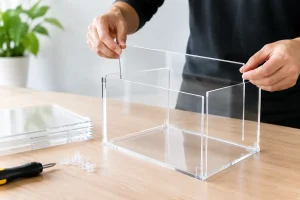
An acrylic display case creates a protective boundary around the build, helping to keep everyday dust, accidental touches and inquisitive pets away from the model. It also makes cleaning the display far less stressful. Rather than working around delicate pieces, you clean the exterior of the case and keep the scene looking sharp.
Generic display boxes can offer basic coverage, but they often leave too much unused space, sit too close to the model, or lack a base that properly presents the build. A set-specific case is designed around the footprint and height of the diorama, so the model has breathing room without looking lost inside a large enclosure.
What makes the best LEGO diorama cases?
The right choice depends on the set, where it will live, and whether you want a clean gallery look or a fully themed backdrop. However, several details separate a collector-grade case from a basic storage solution.
Set-specific dimensions matter
A diorama should never feel squeezed into its display. There needs to be enough clearance above raised scenery and around the sides to protect the build while preserving its silhouette. Too little room makes assembly difficult and increases the chance of catching elements when placing the cover. Too much room weakens the visual impact and leaves the scene looking unfinished.
A case made for the exact set number takes the guesswork out of that decision. It accounts for the model’s dimensions, its display angle and the way the finished build is meant to be seen. This is particularly valuable for scenes with projecting architecture, tall minifigure accessories or layered bases.
Clear acrylic should keep attention on the build
The case should feel almost invisible from a normal viewing distance. Clear acrylic panels allow the colours, texture and detail of the bricks to do the talking, while still giving the display a crisp outline. For collectors who have invested hours in a build, that clarity matters.
Look for neatly cut panels and a design that avoids visually distracting supports across the main viewing area. A clean front panel is especially important for cinematic sets, where the eye should travel naturally across the scene rather than being interrupted by bulky framing.
A printed base can turn a model into a display
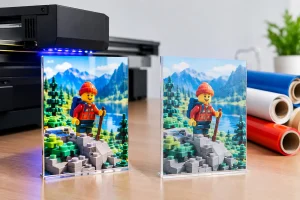
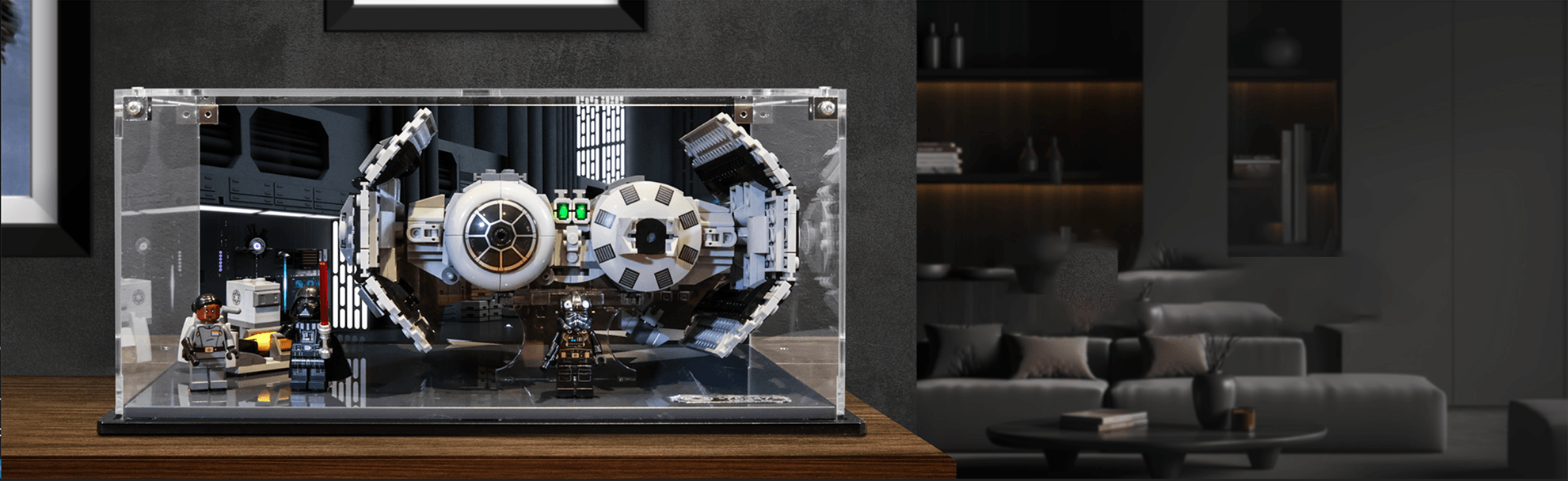
The base does more than hold the case together. It establishes the stage around the set. A plain black base suits a minimalist collection, but a UV-printed base can add terrain, insignia, texture or themed graphics that extend the atmosphere of the scene beyond the bricks themselves.
This works best when the artwork supports the model rather than overwhelms it. A snowy print can add depth beneath a Hoth scene, while darker graphics can give a Star Wars display a more cinematic finish. The aim is to create a display that feels curated, not crowded.
Backgrounds add depth without adding more bricks
Diorama sets often tell their story in a relatively small footprint. A printed background gives that story a wider world. It can create the sense of a hangar, ice planet, forest or dramatic space setting behind the build, transforming a shelf display into a focused scene.
There is a trade-off. A background is ideal if the case will be viewed mainly from the front, where it can deliver maximum visual impact. If your display is positioned in the centre of a room or intended to be enjoyed equally from every side, a clear case without a backdrop may be the better fit. Think about the final location before choosing the presentation style.
Best LEGO diorama cases by display priority
There is no single perfect case for every collector. The best option is the one that matches how you want to enjoy the set after the last brick is placed.
For a clean, gallery-style collection
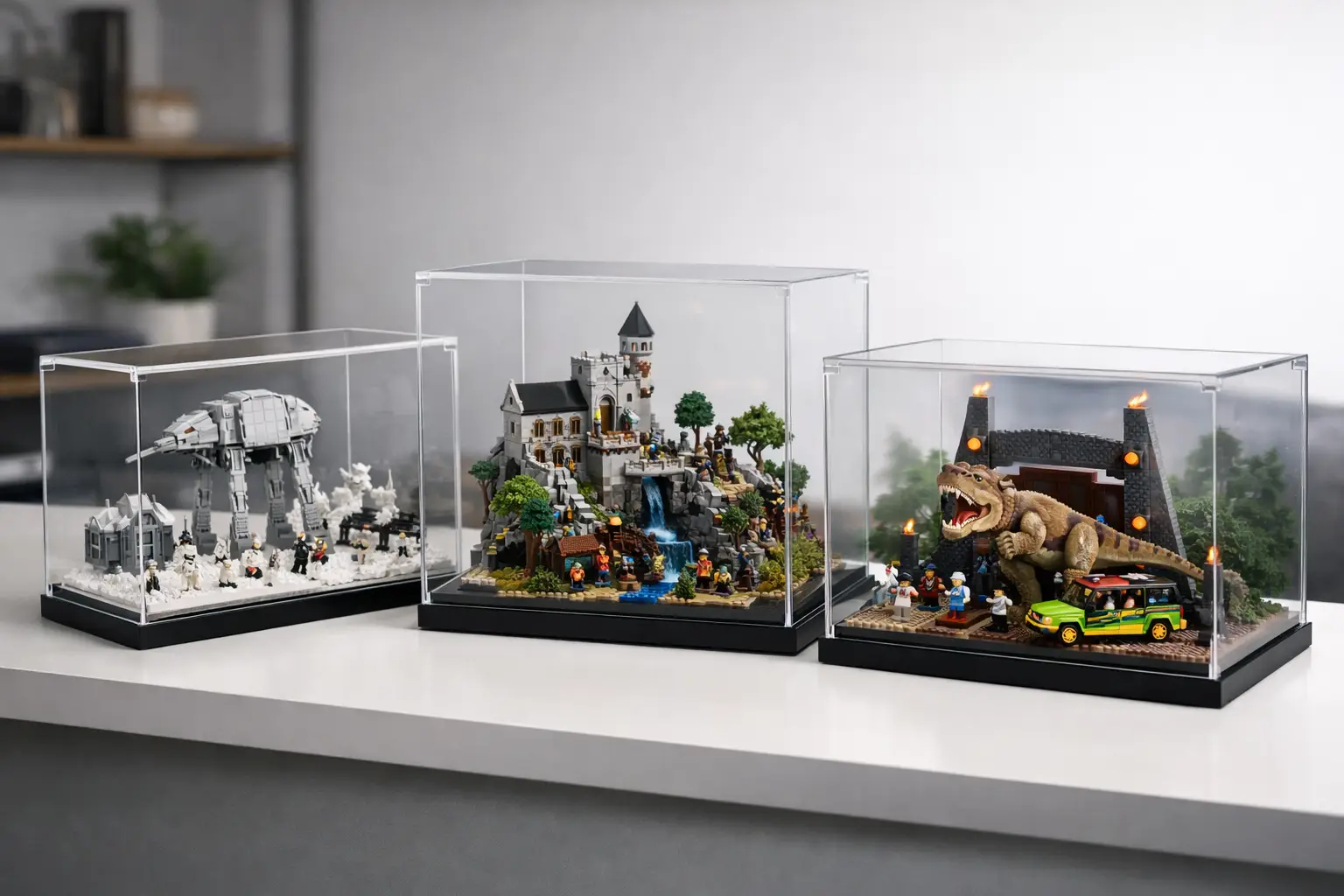
Choose a clear, set-specific acrylic case with a simple base. This approach lets the official build remain the focal point and creates a consistent look when several dioramas are displayed together. It is particularly effective for collectors who mix themes, such as Star Wars scenes alongside Marvel, Harry Potter or Disney builds.
Keep shelf spacing consistent and allow a little room between cases. The result is organised without feeling clinical, and every model has its own defined place.
For immersive Star Wars scenes
A themed printed base and background can make a dramatic difference. Star Wars dioramas are built around atmosphere: shadowy corridors, distant stars, frozen ground and the tension of a recognisable moment. A display case that continues that visual language makes the finished model feel larger than its footprint.
This is where a specialist display solution such as Brixbox earns its place. Set-specific case sizing combined with themed presentation makes the case part of the collection, not an afterthought added to keep dust away.
For shelves with limited depth
Measure first, then choose the most display-efficient case. Dioramas are often purchased because they capture a beloved scene without requiring the space of a full UCS model, but the case adds a little depth and height. Check the usable internal shelf dimensions, not just the advertised size of the furniture.
For a tight shelf, a front-facing background can be especially useful because it concentrates the viewing experience from one direction. Place the case at a comfortable eye level where the scene can be appreciated without constantly moving it for a better angle.
For long-term protection of prized builds
If the set is sentimental, retired, difficult to replace or part of a growing display collection, prioritise coverage and ease of access. A case should protect the model from routine handling while still allowing you to lift the cover away when you want to adjust a minifigure, replace a tile or admire the build up close.
Avoid treating a display case as a sealed archive. LEGO models can still benefit from occasional checks, especially if they are displayed near direct sunlight, radiators or areas prone to humidity. The case protects against dust and casual knocks, but sensible placement protects the bricks themselves.
Before ordering your diorama display case
Start with the precise set number. Sets with similar names can have very different dimensions, and even a small variation in base shape or height can affect the fit. Next, decide whether you want a plain base, printed base, background, or both. That decision should reflect the display location as much as your favourite theme.
Measure the shelf, cabinet or desk where the finished case will stand. Include clearance above the case, particularly if you need to lift a cover vertically for access. Finally, consider the wider collection. A themed case can create a stunning hero display, while matching clear cases may be the smarter choice for a wall of multiple dioramas.
Give the finished scene its rightful place
A diorama may be one of the smallest sets in a collection, but it can hold the biggest emotional punch. Choose a case that respects the details, complements the theme and protects the build from the slow creep of dust. Once the scene is framed properly, it stops looking like it has merely been put on a shelf and starts looking ready for its next audience.
RECENT POST