LEGO Blog
All the latest Brixbox news, straight from the team.
Display Stand or Display Case – Which Is Best?
A completed LEGO set should not disappear into the background the moment the final brick clicks into place. Whether it is a starfighter with fragile wings, a helmet packed with small details or a large-scale Technic model, the way you display it affects how often you enjoy it. Choosing a display stand or display case is not simply a question of where it will fit. It is a decision about protection, presence and how you want the build to feel in your collection.
A stand can turn a model into a dramatic centrepiece, lifting it into a more dynamic pose. A case creates a finished, gallery-style presentation while keeping dust, curious hands and everyday knocks at a distance. Both have their place. The best choice comes down to the set itself, your space and the level of protection your collection deserves.
Display stand or display case: start with the set
Look at the model before you look at the shelf. Some LEGO builds were made to be admired from every angle, while others have a clear front-facing profile that benefits from a themed backdrop and a clean, enclosed frame.
A display stand works particularly well for spacecraft, vehicles and models with motion built into their design. An angled stand can give a ship the feeling of flying through space, reveal details hidden underneath, or make a compact model command more attention on a crowded shelf. Stands are also useful when a set has a small footprint but plenty of vertical character. Rather than taking up valuable surface space, the model gains height and energy.
A display case is often the stronger choice for detailed builds, sentimental sets and larger investments. The clear acrylic panels allow the model to remain visible while creating a barrier against the two things every collector knows too well: dust settling into every stud and accidental damage during cleaning. If a build has delicate antennae, exposed minifigures, loose accessories or intricate scenery, a case gives it a far safer home.
There is no rule that says every set needs the same solution. A fleet of starfighters may look brilliant mounted on stands, while the flagship build in the middle of the room earns the full case treatment. Variety can make a collection feel more intentional, not less cohesive.
When a display stand earns its place
The appeal of a stand is immediate. It changes the silhouette of the model and makes the display feel active. That matters for collectors who want their shelves to capture a moment from a favourite film, race or fantasy world rather than simply line up completed sets.
For vehicles and flying craft, angle is everything. A carefully designed stand can tilt a model into a banking turn, a launch position or a high-speed chase. It also frees up the underside of the build for viewing, which is especially rewarding on sets where the designers have included landing gear, engines or mechanical detail that would otherwise be lost against a shelf.
Stands suit collectors with limited depth, too. A model positioned upright or at an angle can occupy less horizontal space than one displayed flat. This can help when arranging several smaller sets in a bookcase, on a desk or within a dedicated display cabinet.
The trade-off is exposure. A stand does not stop dust, and it offers little defence against a sleeve catching a wingtip or a pet brushing past a low shelf. It is best suited to models you can position away from busy areas and are happy to clean periodically. A soft brush, gentle air blower and a regular routine will keep an open display looking sharp, but it requires commitment.
A stand should also be designed for the model’s balance and connection points. Generic supports can look out of place or place pressure on vulnerable areas. Set-specific display stands are built around the form, weight and visual strengths of a particular model, so the finished result looks deliberate rather than improvised.
Why a display case changes the experience
A display case does more than contain a set. It gives the build a boundary, and that boundary makes the presentation feel complete. Clear acrylic brings a clean, premium finish to a shelf, sideboard or hobby room without hiding the work you have put into the build.
Dust protection is the obvious advantage, but it is not the only one. Cases reduce the need for handling, which helps preserve models with delicate parts, stickers and carefully arranged scenes. They also make cleaning around your collection less stressful. Instead of navigating around exposed builds, you can wipe the exterior of the case and keep the model safely in place.
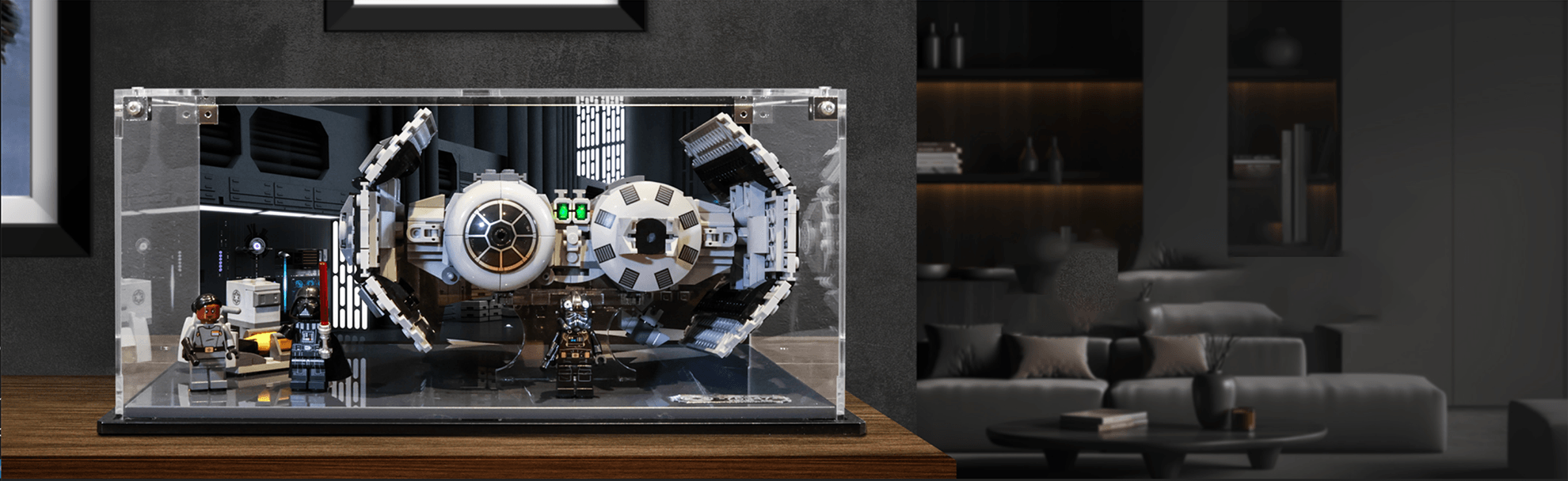
For collectors displaying licensed themes, a printed base or UV-printed background can make an enormous difference. A Star Wars craft can appear against a galactic setting rather than a plain wall. A magical build can gain a dramatic backdrop that reinforces the atmosphere of the set. The model remains the hero, but the display tells more of its story.
This is where purpose-built cases stand apart from generic boxes. Correct dimensions prevent an awkward amount of empty space, while a tailored base keeps the set centred and visually grounded. Brixbox cases are designed around specific sets, allowing collectors to create a display that feels like an extension of the build rather than an afterthought.
The main consideration is space. A case will always take up more room than the model alone, so measure your shelf height, width and depth before choosing one. Remember to account for the case panels, not only the LEGO set dimensions. If you are placing several cases together, leave enough clearance to remove a lid or access the display without moving everything around it.
Choose protection based on where you display
The room matters as much as the model. An open stand can be perfect in a dedicated hobby space where the collection is away from daily traffic. In a family living room, home office or hallway, a case often makes better sense because the model is more likely to be brushed, bumped or handled.
Sunlight is another factor. Direct light can affect colours over time and may create glare on acrylic panels. Neither a stand nor a case makes a set immune to strong sunlight, so choose a position away from a bright window where possible. A case gives you a controlled presentation, but sensible placement remains part of long-term collection care.
Think about air quality as well. Homes with pets, fireplaces or frequent open windows can create more dust than you expect. If you have ever tried to clean a detailed build after a few months on an open shelf, you will understand why a case quickly feels less like an accessory and more like essential kit.
Match the display to the way you collect
Some collectors buy one major set a year and want it to own the room. Others build across several themes, rotating favourites and creating changing scenes. Your collecting style should guide the investment.
If you regularly rebuild, photograph or rearrange models, stands offer flexibility. They make it easier to lift a set out, change its position and refresh the shelf. If you are building a long-term collection you want to preserve, cases create consistency. A row of correctly sized acrylic cases with coordinated printed bases can turn an ordinary shelf into a proper exhibition.
It is also worth considering whether you display the box, instruction manual or minifigures alongside the main set. A case can protect a complete scene, including extra characters and accessories that would be easy to misplace in an open display. A stand keeps the focus tighter, which is ideal when the vehicle or model itself is the star.
The collector’s best answer is often both
The question is rarely whether stands are better than cases in every situation. It is about choosing the right stage for each build. Use a stand when angle, movement and a smaller footprint give the model more impact. Choose a case when protection, presentation and a polished themed finish matter most.
Start with the set you are proudest of. Give it the display it has earned, then let that first properly showcased build set the standard for the rest of your collection.
RECENT POST