LEGO Blog
All the latest Brixbox news, straight from the team.
Buying Guide for LEGO Display Accessories
A finished LEGO set deserves more than the nearest clear patch of shelving. The right buying guide for LEGO display accessories starts with one simple question: what do you want to preserve – the build, the scene around it, or the feeling it gave you when the final brick clicked into place? For collectors, the answer is usually all three.
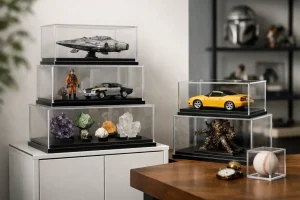
A display accessory should do real work. It should keep dust away from intricate details, reduce the risk of accidental handling, make a set easier to admire and give the collection a more deliberate place at home. Whether you are displaying a flagship Star Wars model, a detailed Technic car, a Hogwarts centrepiece or a growing line-up of helmets and minifigures, choosing by set, space and display goal will produce a far better result than buying a generic box and hoping for the best.
Start with the set, not the shelf
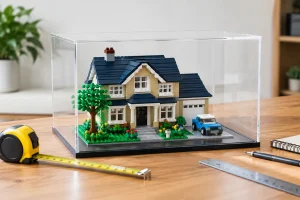
The set itself should lead every decision. Large builds need room around them as well as above them; compact models may benefit more from a raised stand or a wall-friendly arrangement. Before choosing a case or base, measure the finished model at its widest, tallest and deepest points. Include protruding wings, antennae, open doors, display plaques and any pose you intend to use.
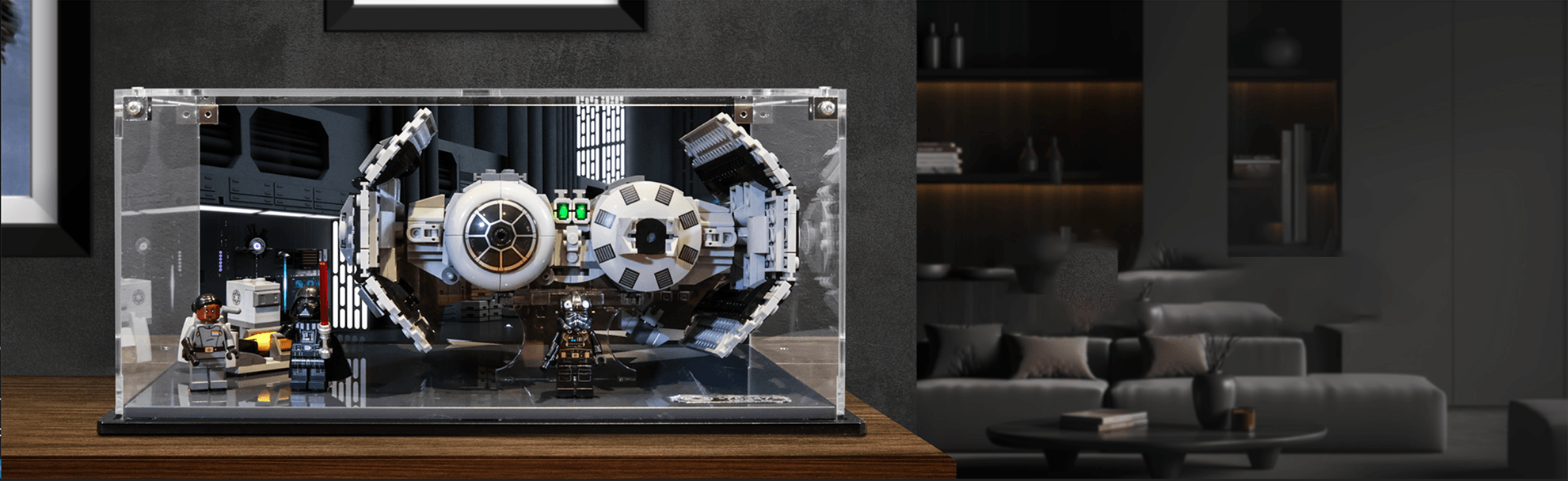
Then think about the set’s personality. A UCS-style spacecraft often looks strongest in a case with a themed printed background that creates a sense of scale. A supercar or Formula 1 build may deserve a printed base that turns a shelf into a pit lane. Character models, BrickHeadz and helmets can form a satisfying repeated display, where matching case proportions bring visual order to a collection that might otherwise feel scattered.
Set-specific accessories are worth prioritising because fit affects both protection and presentation. A purpose-built acrylic display case gives a model sensible clearance without leaving it stranded in a cavern of empty space. It also avoids the awkward compromise of squeezing an expensive build into a case that was never designed for it.
Choose the right type of LEGO display accessory
Acrylic display cases for dust protection
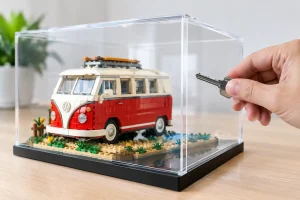
For many collectors, an acrylic display case is the first upgrade that changes everything. Dust settles quickly in studs, cockpit interiors, foliage, mechanical details and textured landscapes. Removing it is tedious, and repeated cleaning can mean touching delicate sections far more often than you would like.
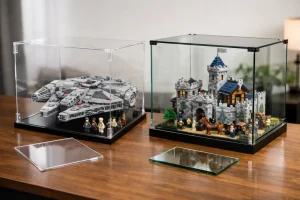
A well-fitted case creates a protective barrier while keeping the model fully visible. Look for clear panels, clean joins, a stable base and enough internal height for the finished display. If the set has a busy silhouette, such as a dragon, starfighter or tall castle tower, do not treat clearance as a small detail. A cramped case can make a spectacular model look oddly constrained.
There is a trade-off. Cases take up more shelf depth than an uncovered build and require a little care when assembling or moving them. For premium, sentimental or particularly fiddly sets, that is usually a worthwhile exchange for less dusting and a more polished finish.
Printed bases and backgrounds for atmosphere
A case protects the model. A printed base or UV-printed background gives it a setting. This is where a display moves beyond storage and becomes part of the collection itself.
Choose artwork that supports the subject rather than competes with it. Dark space-themed backdrops can make light-coloured spacecraft and helmets stand out. Architectural or magical scenes can add depth behind a Harry Potter build. Racing-inspired graphics work brilliantly with Technic and motorsport models, especially where the set’s angles and decals already carry a sense of movement.
The best designs leave the model as the focal point. If your room is already full of colour, a more restrained base may be the better choice. If the set sits alone on a feature shelf, a bolder background can bring the legend to life and make the display feel complete from every viewing angle.
Display stands for better angles
Not every build should sit flat. Display stands are especially effective for aircraft, starships, cars and models whose strongest details are hidden at shelf level. Raising a set can reveal an underside, sharpen its profile and create the impression of flight or speed without adding visual clutter.
Check that a stand is designed for your exact model or at least its weight and connection points. The goal is a secure, balanced pose, not a dramatic angle that puts strain on the build. This matters for larger sets, where an impressive display position must still be practical when you need to dust nearby or rearrange a room.
A stand also changes the space you need. A model may occupy less depth when elevated, but it can become taller or wider. Map out the full silhouette before committing, particularly if it will live beneath a cabinet, on a bookcase or alongside other cases.
Storage solutions for the collection behind the display
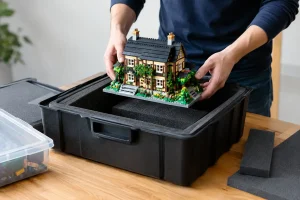
Display and storage work best as a pair. Finished sets deserve the spotlight, but spare elements, instructions, minifigure accessories and unopened projects need an organised home too. Clear, labelled storage keeps loose parts from migrating into drawers and makes future rebuilds far less frustrating.
Decide what stays accessible. If you regularly change minifigure scenes or enjoy rebuilding, compartmentalised storage for smaller elements is useful. If a set is being kept intact for years, storing its instructions flat, dry and away from direct sunlight is often the smarter priority. The aim is not to hide your hobby away. It is to make every part of it easier to enjoy.
Buying guide for LEGO display accessories: check the practical details
A brilliant-looking display that does not suit your home will quickly become a compromise. Measure the intended shelf, including the distance to the wall and the height below the next shelf. Leave enough room to lift a case lid or remove a cover comfortably. Also consider light. Direct sunlight can affect printed elements and packaging over time, while strong spotlights may create distracting reflections on clear acrylic.
Think about access before you choose a permanent layout. A fully enclosed case is ideal for a model you want to preserve untouched. An open stand may suit a build you frequently photograph, adjust or show to visitors. Families with pets, younger children or busy living spaces will usually get more value from enclosed protection, particularly for models with fragile sections.
Material quality matters as much as the dimensions. Clear acrylic should enhance the view rather than turn it hazy. Bases should feel stable on the chosen surface, and printed elements should look crisp enough to reward a closer look. Premium accessories are not merely an add-on after the build. They are the framework that lets the build look its best every day.
Build a display that feels collected, not crowded
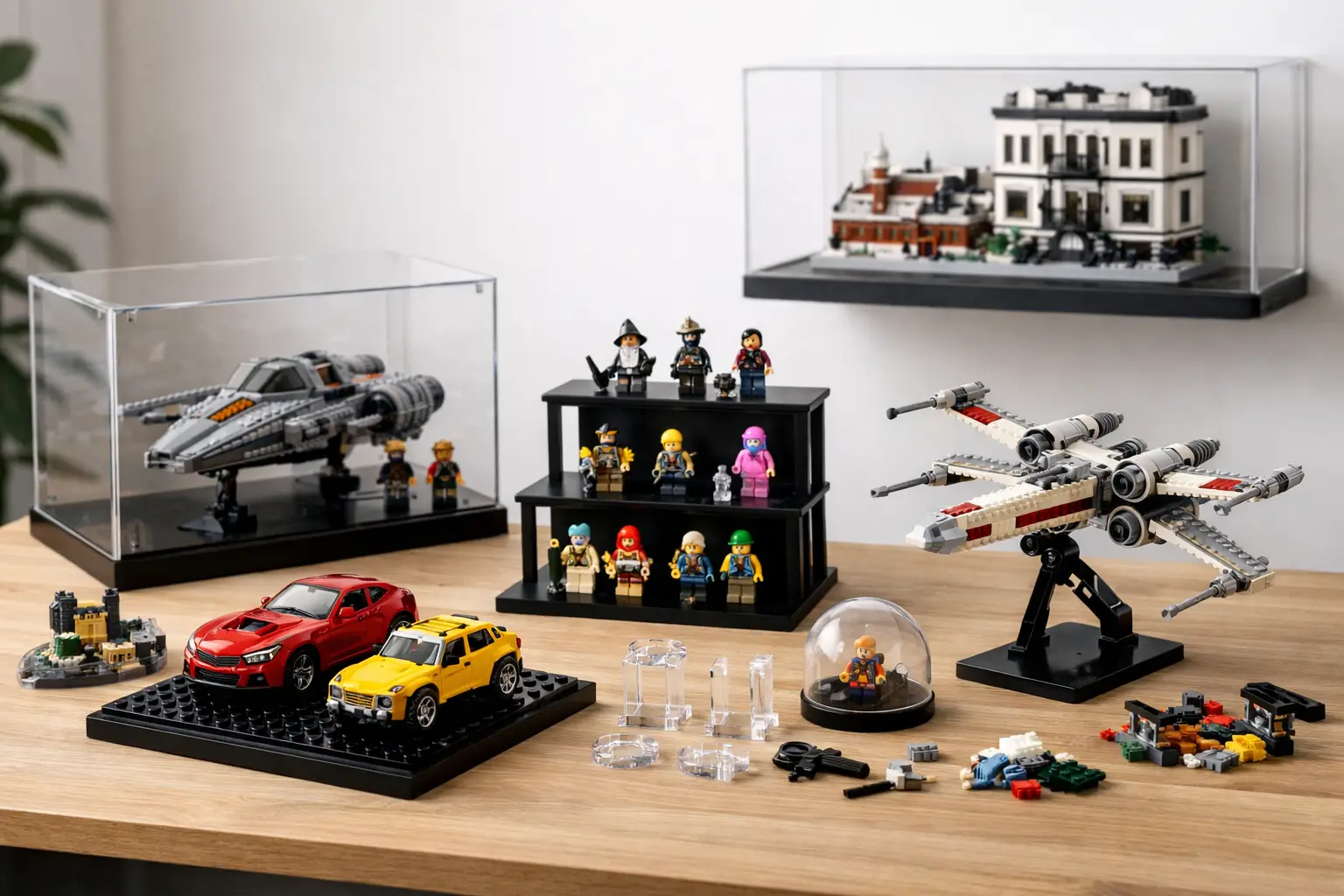
It is tempting to give every set its own statement case, but a collection gains impact from contrast. Use your largest or most meaningful model as an anchor, then arrange smaller displays around it with breathing room. Matching bases or a consistent case style can unite different themes without making the shelf feel like a showroom.
Group by story when it feels right: a line of Star Wars helmets, a fleet of ships, a motorsport grid or a magical corner of favourite Wizarding World sets. Alternatively, group by display scale, keeping taller cases together and smaller models at eye level. There is no single correct approach. A shelf built around nostalgia can be every bit as striking as one arranged by colour or theme.
If you are starting with one upgrade, protect the set you would be most upset to clean, repair or replace. Brixbox specialises in set-specific cases, stands and themed presentation pieces because collectors should not have to choose between keeping a build safe and making it look extraordinary.
Your collection does not need to be the biggest to command attention. Give the next finished set the space, protection and backdrop it deserves, then let the display tell the story long after building day.
RECENT POST