LEGO Blog
All the latest Brixbox news, straight from the team.

Vertical Stand for LEGO Ships: Display It Right
A capital ship built from thousands of pieces deserves better than lying flat at the back of a shelf. A vertical stand for LEGO ships changes the entire presence of a finished model, lifting the hull into view, freeing up valuable display space and showing off the angles that made you want to build it in the first place.
For collectors of large Star Wars vessels, classic sailing ships, spacecraft and brick-built naval icons, the appeal is obvious. These are not sets designed to disappear into a crowded bookcase. They are centrepieces. The right stand turns a model from a superb build into a properly considered display.
Why display LEGO ships vertically?
Large LEGO ships are often impressive from above, but their most dramatic details sit along the side profile: layered hull plating, cannon ports, engines, fins, radar arrays and carefully shaped bows. Displaying a ship vertically or on a steep angle makes those details visible at a glance rather than hiding them below the shelf line.
There is also the practical benefit. Long ships consume a surprising amount of horizontal shelf space, especially when displayed on their original base. A vertical presentation uses height instead, making it possible to create a fleet display in a cabinet, on a wall-adjacent shelf or within a carefully planned collector’s room.
That does not mean every ship should be stood upright. A model with fragile masts, an uneven underside or a particularly broad wing span may be safer on a traditional horizontal base. The best choice depends on the model’s weight distribution, its strongest connection points and how much handling the display will receive.
What makes a good vertical stand for LEGO ships?
A premium display stand should feel as considered as the set it supports. Generic brackets and improvised supports may get a model off the shelf, but they can place pressure on the wrong pieces, obscure key details or leave your prized build looking precarious.
Secure support at the right points
The stand must support the strongest areas of the build, rather than loading delicate tiles, exterior panels or decorative elements. For many large ships, that means bearing weight beneath a reinforced section of the hull or using multiple contact points to spread the load evenly.
This is particularly important for heavy models. Brick-built ships are strong when their internal structure is properly supported, but they are not solid plastic ornaments. Over time, a badly positioned stand can encourage sagging, loosen connections or place unnecessary strain on a section that was never intended to carry the whole model.
A well-designed stand holds the ship confidently without forcing it into position. You should not have to flex the hull, remove major parts or hope that a handful of studs will keep a large set secure.
An angle that shows the model at its best
Vertical does not always mean completely upright. A slight lean can often be the smarter option, especially for longer vessels or models with a deep lower hull. It creates the visual impact of a wall-mounted display while keeping the centre of gravity more manageable.
Think about what you want to see first when you enter the room. A Star Wars capital ship may look best with its bow angled outward and its engines visible. A sailing ship may benefit from a pose that reveals its deck, rigging and side profile together. The ideal angle should celebrate the set’s design, not simply save space.
A base with real presence
The base does more than stop the display from tipping. It grounds the piece visually. Clear acrylic can create a floating effect that suits spacecraft and futuristic fleets, while a printed base can add a sense of location, scale and story.
For themed collections, presentation matters. A dramatic background or printed base can make a ship feel as though it has just emerged from hyperspace, crossed a stormy sea or entered a scene from a favourite saga. The difference is not subtle. It gives the whole display a more finished, collector-grade look.
Room to protect the build
If dust is the enemy of a pristine collection, a stand alone may not be the final answer. Upright models can expose more surface area, including the intricate greebling, antennas and recessed sections that are awkward to clean properly.
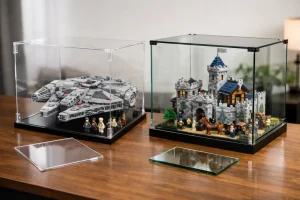
A display case paired with a purpose-built stand offers a more complete solution. It protects the model from dust, reduces casual handling and helps preserve the sharp presentation that made the build special on day one. For expensive, retired or sentimental sets, that extra protection is often well worth considering.
Measure before choosing a display position
Before committing to a vertical ship display, measure the model itself, not just the shelf. Include the highest antenna, widest wing, longest cannon or mast, and any part that projects beyond the central hull. LEGO ships rarely fit neatly into a simple length-by-width measurement.
You will also need to account for the stand’s footprint and the clearance needed above the model. A ship may technically fit inside a cabinet but still look cramped if its nose nearly touches the acrylic or its topmost detail sits against a shelf.
Leave enough breathing room around the build for it to read as a centrepiece. Crowding a detailed ship between boxes, books or smaller models loses much of the impact that a vertical stand is meant to create.
Choosing the right display location
A vertical display is naturally eye-catching, so position it where that attention works in its favour. A high shelf can make a fleet look imposing, but it is not always the safest option for a heavy build. If the model requires occasional dusting, adjustment or close inspection, a position around chest or eye level is usually more practical.
Avoid direct sunlight where possible. Prolonged UV exposure can affect colours over time, particularly on lighter bricks. Keep the display away from radiators, humid areas and busy routes where a passing sleeve, pet or excited visitor could catch an exposed wing or mast.
Collectors with limited room often find that vertical stands make display cabinets work harder. Instead of arranging ships nose-to-tail across a single shelf, you can vary height, angle and depth to build a more theatrical scene. The key is consistency. A carefully spaced collection looks intentional; a row of different models at random angles can look untidy, however impressive the sets may be individually.
Set-specific design beats a one-size-fits-all solution
Every ship has its own geometry. Some feature smooth, broad undersides. Others have landing gear, exposed engines, complex curves or asymmetrical details that make standard supports unsuitable. This is where a set-specific display solution earns its place.
Purpose-built stands are designed around the model’s structure and proportions. They can position the ship at a flattering angle, avoid pressure on vulnerable elements and create a cleaner silhouette than a generic easel-style support. For collectors who have invested time, money and patience into a flagship build, that precision matters.
The same is true of display cases. A case tailored to a particular set gives the model enough clearance and avoids the awkward empty space or tight fit common with universal boxes. Add a themed printed base or UV-printed background and the display becomes an extension of the set, not an afterthought.
A few handling habits that protect your display
Once your ship is mounted, resist the temptation to move it by grabbing the nearest wing, mast or upper hull panel. Lift from the reinforced underside or follow the handling points recommended for the specific stand. If the model is especially large, two hands are essential and two people may be sensible.
Check the stand periodically, particularly after moving furniture or cleaning around the display. Look for loosened bricks, shifted contact points and dust gathering around the base. A quick, careful inspection is far easier than rebuilding a section after an avoidable wobble.
If you rotate your displays seasonally or make room for new arrivals, keep the original instructions and any spare elements nearby. It is useful to have them ready should a delicate detail need refitting after a move.
A vertical ship display should make your collection feel bigger, sharper and more intentional – not more fragile. Choose a stand that respects the build, give it the space it deserves and let the silhouette do the talking. At Brixbox, that is the difference between storing a set and showcasing a legend.
RECENT POST