LEGO Blog
All the latest Brixbox news, straight from the team.
How to Curate LEGO Collections That Stand Out
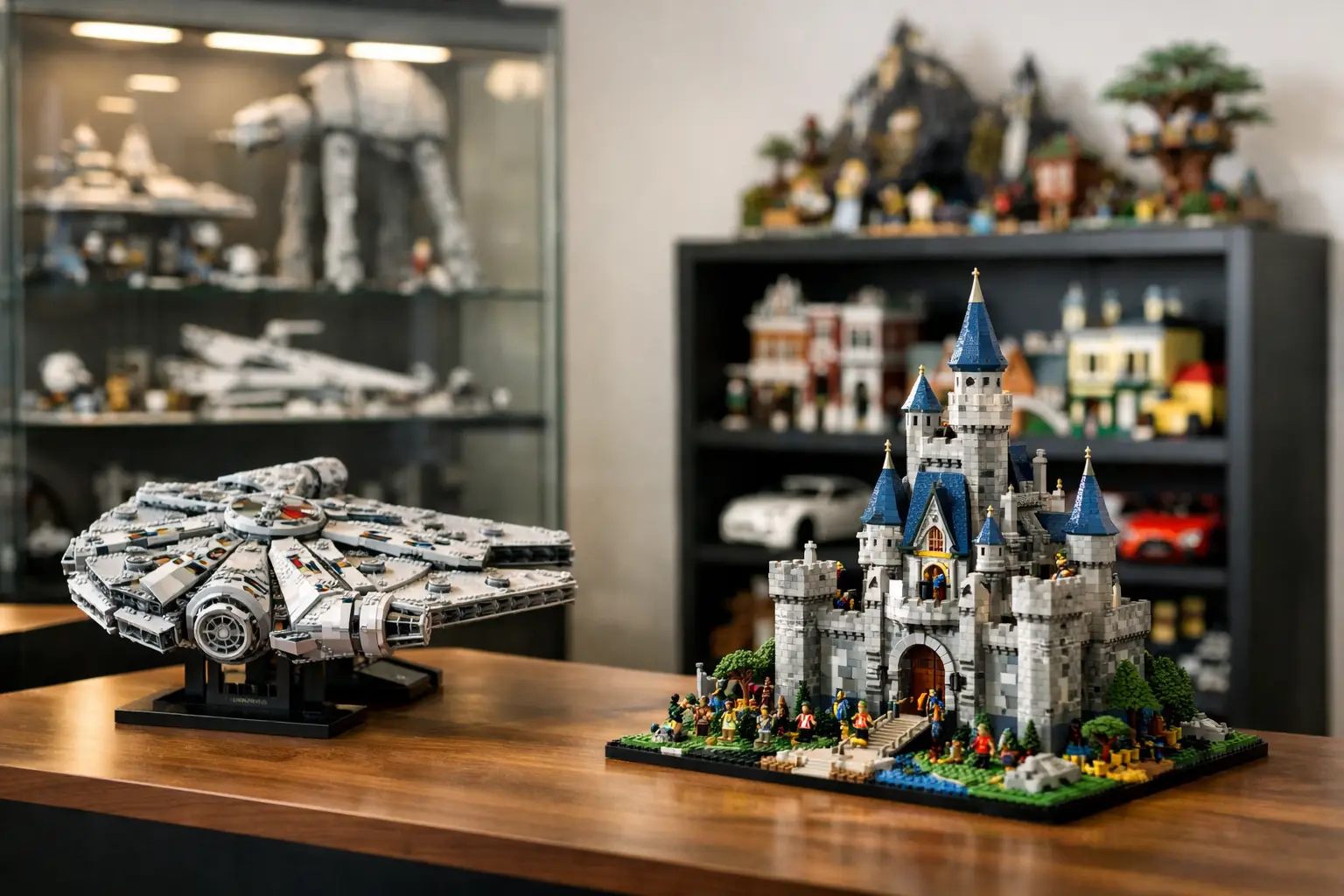
A finished LEGO set deserves more than the nearest spare shelf. Knowing how to curate LEGO collections is what turns a row of brilliant builds into a display with character, scale and a story worth stopping for. Whether your prize piece is the UCS Millennium Falcon, Hogwarts Castle, a Technic supercar or a growing line-up of helmets, the aim is not to show everything at once. It is to make every set feel chosen.
Start with the story you want your collection to tell
The strongest collections have a point of view. That does not mean limiting yourself to one theme forever, but it does mean deciding what should lead the display. A Star Wars collector might build a shelf around the contrast between ships, helmets and minifigures. A Harry Potter fan could create a magical journey from smaller moments to a centrepiece castle. A motorsport display may focus on engineering, speed and clean, gallery-style presentation.
Choose one or two core themes, then give yourself a simple rule for additions. It could be that every set must represent a favourite scene, character, vehicle or design era. It could be that only display-worthy builds earn permanent shelf space. This small amount of restraint protects your budget, prevents visual clutter and makes new arrivals feel exciting rather than overwhelming.
There is room for exceptions. A sentimental set built with family, a once-in-a-lifetime gift or a model you simply love can sit outside the main theme. Curating is not about following rules for their own sake. It is about making deliberate choices so your collection looks like yours.
How to curate LEGO collections by scale and priority
Before buying another cabinet or rearranging a shelf, separate your sets into three groups: centrepieces, supporting builds and rotating pieces. This is one of the easiest ways to make a collection feel organised without making it feel rigid.
Centrepieces are the models that set the tone. They are usually large, detailed, expensive or personally meaningful, such as a UCS starship, a landmark architecture build, a large vehicle or an iconic castle. Give these sets room to breathe. Crowding a major build with smaller boxes, loose minifigures and unrelated accessories weakens the impact you paid and built for.
Supporting builds create context. A TIE Fighter beside an Imperial helmet, smaller Hogwarts modules around a larger wizarding-world display, or a matching race car alongside a flagship Technic model can make the whole arrangement feel more intentional. Aim for a balance of heights and shapes rather than lining up every model like products in a shop aisle.
Rotating pieces are the seasonal, newly built or less permanent sets that keep your display fresh. This approach is particularly useful when space is tight. Instead of trying to fit every build into view, give yourself a rotation shelf. A winter village scene, a new release or an older favourite can take its turn without forcing you to dismantle something special.
Give each set the right amount of space
A display needs negative space. Collectors often underestimate it because a bare patch of shelf can look like wasted storage. In reality, that space lets the outline, colours and detail of each build register properly. It also makes dusting and handling far less risky.
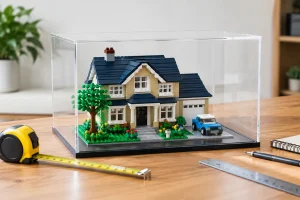
Leave enough clearance around wings, antennae, raised sections and delicate foliage. Large models benefit from viewing room at the front as well as the sides, especially if you want to admire the build from more than one angle. Smaller sets can be grouped closer together, but only when they share a clear connection, such as a fleet, a scene, a character line-up or a colour palette.
Think about sightlines too. The best shelf is not always the one with the most room. A set displayed at eye level will naturally become a focal point, while a low shelf suits larger models that benefit from looking down into cockpits, interiors and landscaping. Keep fragile, high-value builds away from busy routes through the room, wagging tails and curious hands where possible.
Build visual rhythm, not a brick wall
A collection looks more polished when tall, low, wide and compact models are arranged with purpose. Alternate heights where you can, using display stands or raised bases to stop smaller builds disappearing behind larger ones. Avoid placing every large model at the back and every small model at the front unless you are building a deliberate scene.
Colour matters as well. Dark Star Wars ships can look striking against a lighter printed background, while brightly coloured Disney sets often benefit from cleaner surroundings that allow their details to pop. The goal is not a perfectly matching room. It is enough contrast for the build to be seen properly.
Protect the sets you have chosen to keep
A curated collection should be easy to enjoy, not a weekly cleaning project. Dust settles quickly on exposed studs, transparent elements and intricate interiors, and it is particularly noticeable on black, white and dark blue pieces. The more detailed the model, the more time cleaning can take.
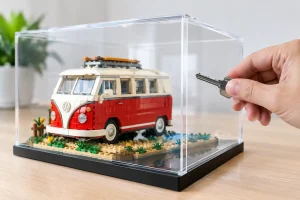
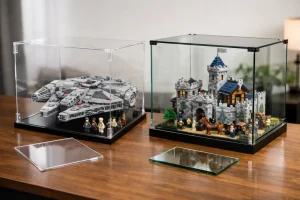
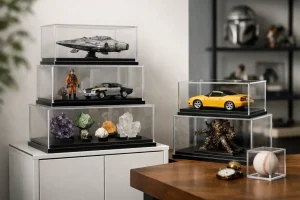
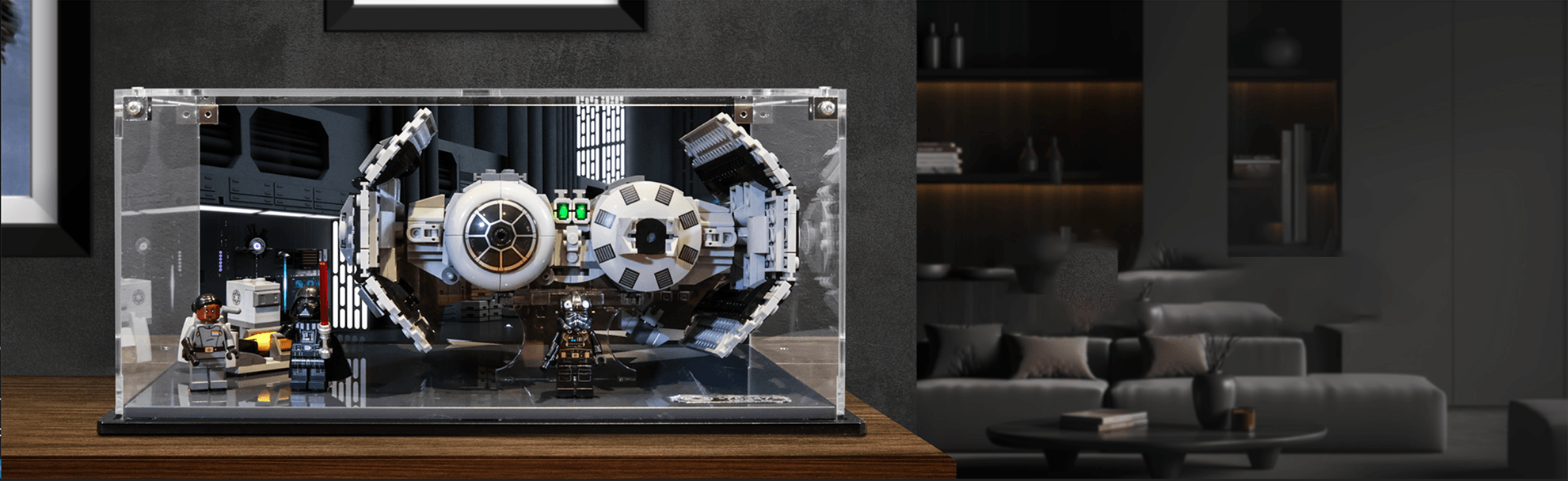
Acrylic display cases are a practical answer for the sets that matter most. They reduce dust and accidental handling while giving a finished build the kind of defined presentation it deserves. For collectors, the best cases are designed around the specific model, with enough room for its proportions and any display angle, rather than asking a treasured set to fit a generic box.
Printed bases and themed backgrounds can add another layer of atmosphere without altering the model itself. A well-chosen backdrop gives a spaceship the sense of travelling through space, adds depth behind a castle, or creates a premium garage feel for a supercar. Use them selectively. If every shelf has a competing graphic, the room can begin to feel noisy. Save the most immersive presentation for your centrepieces.
At Brixbox, set-specific cases, bases and backgrounds are designed for exactly this balance: protection first, with presentation that brings the identity of the build forward.
Keep boxes, instructions and spare elements organised
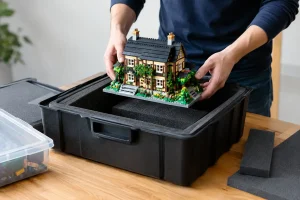
The display is only one half of a well-curated collection. Original boxes can be valuable to collectors and are often worth retaining for premium, retired or sentimental sets. Flattening boxes may save space, but it can affect their condition and is not always ideal if you care about long-term collectability. If space is limited, prioritise boxes for your highest-value sets and recycle packaging from builds you know you will never resell.
Store instruction booklets flat, dry and out of direct sunlight. A labelled archive box or document storage solution is far better than a precarious stack at the bottom of a wardrobe. For spare parts, use small labelled compartments by colour, part type or set number. Set-number storage is slower to organise initially, but invaluable when a specific piece disappears during a house move or a display refresh.
Keep a simple digital inventory, too. Record the set number, purchase date, whether the box and instructions are complete, and where it is displayed or stored. It is not glamorous, but it makes insurance records, rearranging and future collecting decisions much easier.
Edit your shelves as the collection grows
Every new set changes the balance of a display. Rather than squeezing it into the last available gap, ask what it adds. Does it strengthen an existing theme? Does it replace a smaller build that no longer feels as special? Or does it deserve its own dedicated moment?
A good edit is not a failure of collecting. It is how a collection stays impressive as your taste changes. You may decide to sell, gift, rebuild or carefully store sets that no longer fit the direction. That creates space for the pieces you genuinely want to see every day, and it makes the collection feel more personal with every decision.
The best display does not prove how many sets you own. It shows which stories, worlds and builds you care about enough to protect, present and enjoy again every time you walk past.
RECENT POST