LEGO Blog
All the latest Brixbox news, straight from the team.
LEGO Storage That Protects Every Great Build
A freshly built UCS starfighter, Hogwarts castle or Technic supercar deserves better than becoming a dust magnet on an open shelf. Great LEGO storage is not simply about finding somewhere to put bricks. It is about protecting the time, money and imagination invested in every set, while making the collection a feature of the room rather than a source of clutter.
For serious collectors, the answer is rarely one oversized plastic tub. Loose parts, instruction manuals, spare elements and completed display models all need different treatment. Get that distinction right and your collection is easier to enjoy, easier to maintain and far more impressive to showcase.
Start by separating builds from bricks
The biggest storage mistake is treating every piece of LEGO the same. A completed model is a display piece. A box of loose elements is a creative resource. A set waiting to be built is an occasion in the making. Each calls for its own place.
Completed sets need a stable, low-traffic home where they will not be knocked during everyday life. This matters particularly for detailed models with exposed greebling, delicate antennae, large wings or carefully placed minifigures. A shelf may be enough for a sturdy, compact build, but premium sets benefit from a purpose-built display case that keeps dust and curious hands at a respectful distance.
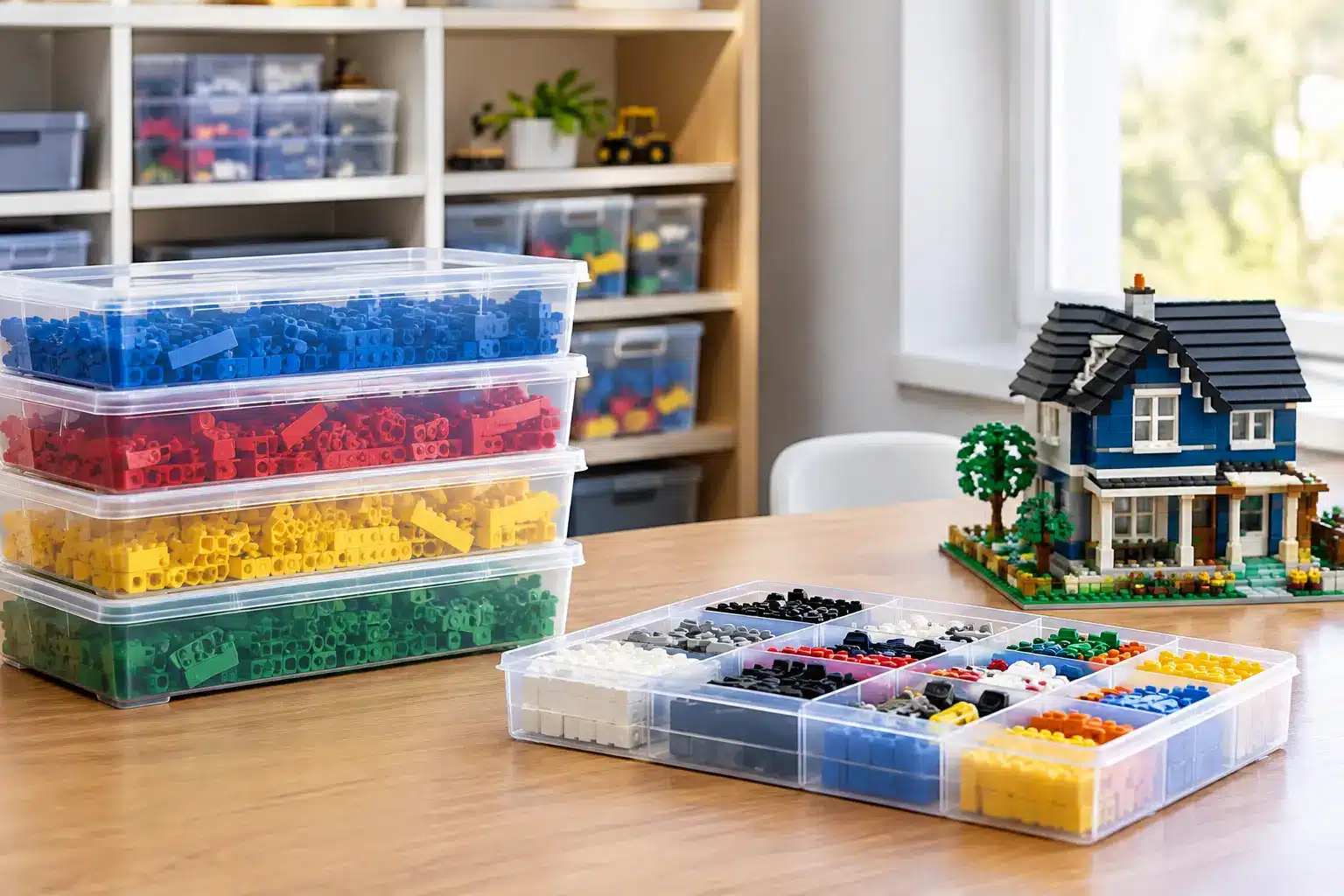
Loose bricks are different. Their value lies in being easy to find. Store them by part type, size or colour depending on how you build. Colour sorting works well for younger builders and casual creative play, while experienced MOC builders often find it faster to sort by element type: plates together, slopes together, tiles together, and so on. The right approach is the one that helps you locate a 1×2 grille or a particular wedge without tipping out an entire box.
LEGO storage should protect the finished story
A display shelf can hold a model, but it does not necessarily protect it. Dust settles into studs, windscreens and tiny mechanical details with surprising speed. Cleaning can be slow work, especially on complex licensed sets, and repeated handling creates opportunities for parts to loosen or disappear.
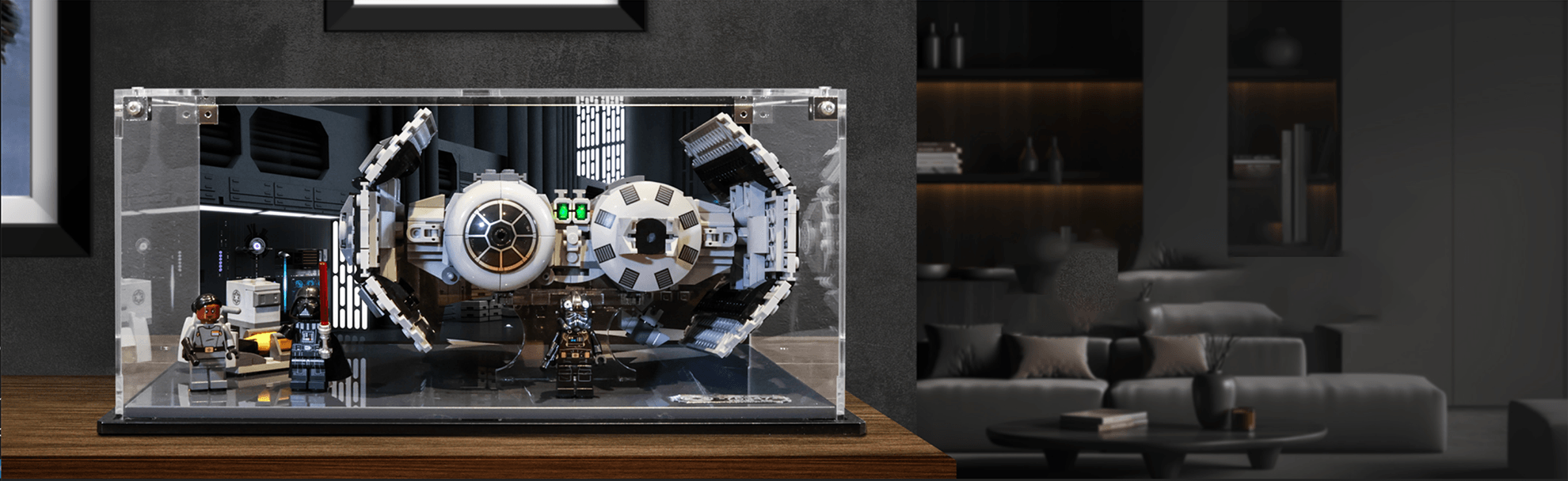
A clear acrylic display case changes the role of storage. It protects the build while keeping every detail visible, from a dramatic Star Wars trench run scene to the printed dashboard inside a Technic cockpit. For collectors who have chosen a set for its visual impact, hiding it in a cupboard is rarely satisfying. The better option is to give it a home where it can be seen properly.
Set-specific cases are particularly worthwhile when the model has an unusual footprint or needs room for a display stand. A close, considered fit looks cleaner than a generic box and avoids the awkward empty space that can make a centrepiece feel lost. It also helps the whole collection look intentional, whether you have one prized build in the living room or a dedicated display wall.
The visual finish matters too. A printed base or themed background can turn a great model into a complete scene. Think of a helmet displayed against artwork that matches its universe, or a spacecraft elevated above a graphic backdrop rather than placed against a plain wall. Storage then becomes part of the presentation, not an afterthought.
Choose your display location with care
Even the best case needs the right position. Keep valuable sets away from direct sunlight where possible, as prolonged exposure can affect colours over time. Avoid spots beside radiators, humid bathrooms and places where doors are regularly slammed. A sturdy cabinet, bookcase or wall-mounted shelf is generally a stronger choice than the edge of a desk or a crowded windowsill.
Before choosing a case, measure the available space as well as the set itself. Leave enough room around it to open a cabinet door, clean the surrounding area and add future builds without creating a cramped line-up. Collections tend to grow faster than expected.
Organise unopened sets, manuals and spare parts
Not every collector opens every box straight away. Some sets are bought for a birthday, a rainy weekend, a future project or simply because a favourite theme cannot be missed. Keep sealed boxes upright where practical, out of direct light and away from damp. Stacking is fine for lighter boxes, but avoid putting heavy sets on top of smaller ones that could crush or bow.
Instruction manuals deserve more respect than the average coffee-table magazine. Store them flat in protective sleeves or a labelled document box, especially for retired or sentimental sets. Digital instructions are useful at the building table, but the original booklet remains part of the set for many collectors.
Spare pieces are easiest to manage when they stay connected to their set. Small labelled bags or divided organisers work well. Include the set number on the label, rather than relying on memory months later. This is especially useful when several models use similar colours and elements.
For a large collection, a simple inventory makes a real difference. You do not need a complicated system. A note of set number, theme, location and whether the set is built, boxed or displayed is enough to stop duplicate purchases and frantic searches before a rebuild.
Build a LEGO storage system that can grow
The most satisfying collections are not necessarily the biggest. They are the ones with enough room for each build to breathe. Plan storage with the next few additions in mind, rather than filling every shelf from day one.
Start with your priority sets. These are the builds you want to see every day: the UCS centrepiece, the favourite Hogwarts display, the Marvel scene that always gets comments, or the Technic car that deserves pride of place. Protect and showcase these first. Less visually dramatic models can sit on open shelving, while loose bricks and works-in-progress belong in labelled drawers or lidded boxes nearby.
Try to group displays by theme, scale or colour palette. A run of Star Wars ships reads differently when it is arranged as a fleet. A shelf of helmets gains presence when the cases line up cleanly. That said, do not force every set into a rigid theme. Sometimes a single bold build deserves its own stage.
Brixbox cases are designed for collectors who want that stage to feel as considered as the build itself. A set-specific fit, clear acrylic protection and themed printed options can bring the legend to life without stealing attention from the model.
Avoid the common shortcuts
Plastic tubs have a place, but they are not a complete answer. They can be ideal for bulk elements, duplicate parts and active building projects. They are less suitable for finished models, where pressure, movement and stacking can lead to bent parts and broken sections.
Open shelving is similarly a trade-off. It offers quick access and can look brilliant at first, but it demands regular dusting and exposes fragile details. If you enjoy rearranging displays often, shelves may suit you. If you want long-term protection with minimal maintenance, cases are the stronger choice.
Be cautious with overly tight containers too. A model should not touch the sides of its storage solution, and there should be enough clearance above tall features such as masts, wings and antennae. Storage should reduce risk, not introduce it.
Make maintaining the collection easy
The best system is one you can keep up with. Give every category a clear home, label containers in a way that makes sense to you and leave a little empty space for incoming sets. When a new build arrives, you should know where its box, booklet, spare parts and finished model will go before the first bag is opened.
For displayed sets, a light clean of the exterior of the case is usually far easier than dusting every exposed stud. When moving a model, support it from its strongest structural points rather than lifting by a wing, roof, tower or decorative section. And if a set needs rebuilding after a move, treat that as part of the hobby, not a failure of the display.
Your collection has earned more than a spare corner and a layer of dust. Give the bricks you build with room to create, and give the builds you love a protected place to be admired.
RECENT POST