LEGO Blog
All the latest Brixbox news, straight from the team.
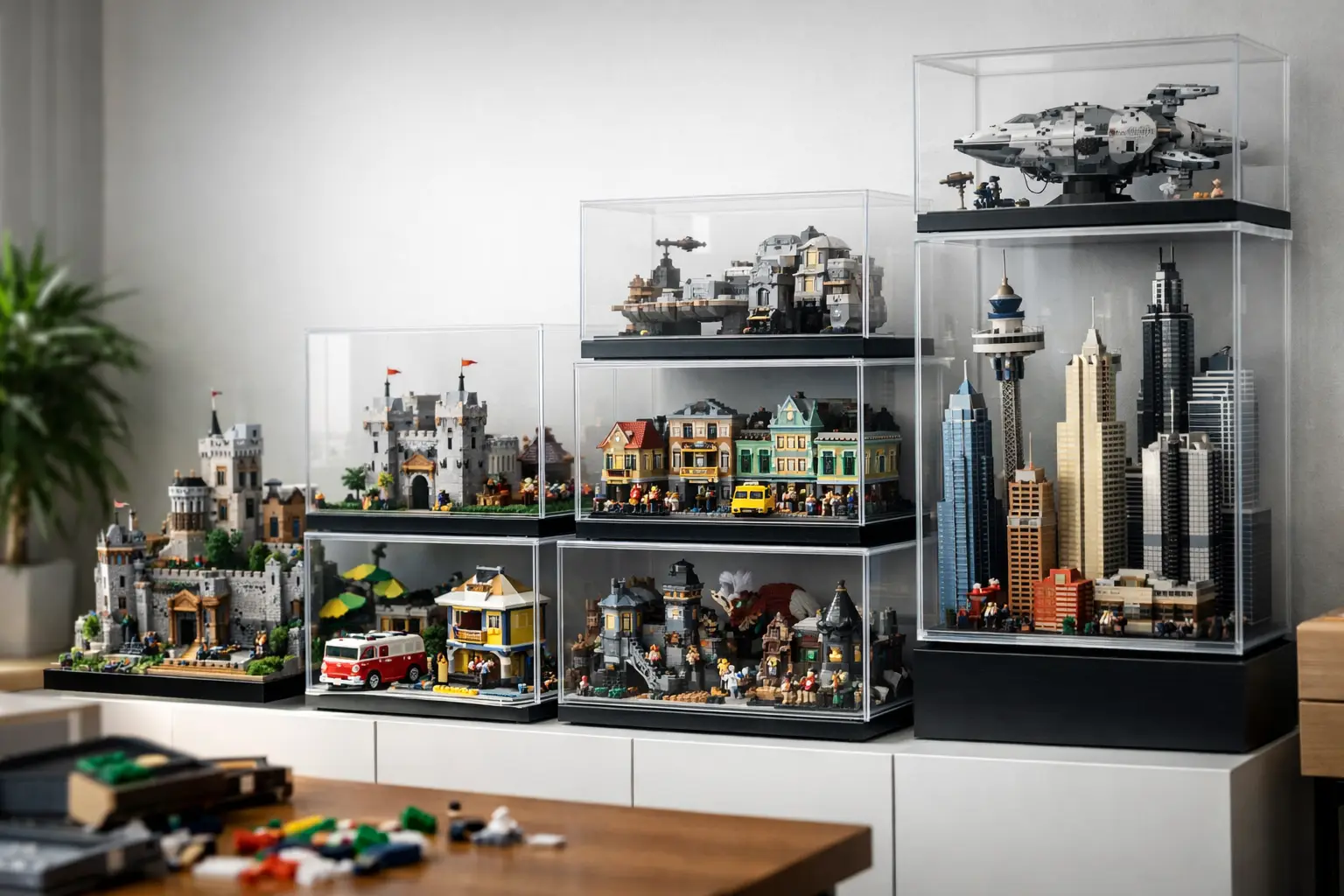
How Modular LEGO Displays Grow With Your Collection
A new set should feel like an addition to your collection, not a shelving crisis. That is the real appeal of modular LEGO displays: they let a single prized build look complete today while giving your display room to evolve tomorrow. Whether you are building a Star Wars fleet, a growing line-up of helmets, or a shelf of Technic icons, the aim is the same – create a presentation that feels considered, protected and unmistakably yours.
For serious collectors, modular does not have to mean every case is identical. It means your display has a repeatable logic. Cases, stands, shelves and lighting work together in a way that can be extended without turning the room into a mismatched wall of boxes.
What makes a LEGO display truly modular?
A modular display is built around units that can sit confidently on their own and still belong to a wider arrangement. Those units might be acrylic cases for individual flagship sets, matching cases for a run of helmets, tiered minifigure displays, or a repeated shelf layout with consistent spacing and colour treatment.
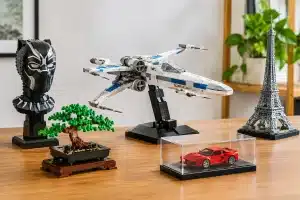
The important part is visual rhythm. When new builds arrive, you should be able to place them without rethinking the whole collection. A display with repeated heights, compatible shelf depths and a consistent backdrop style feels intentional even when it spans completely different themes.
There is a practical benefit too. LEGO collections rarely stay still. One premium set becomes a theme, a theme becomes a dedicated shelf, and suddenly the spare space you thought you had has disappeared. A modular approach makes that growth easier to manage because you are planning the framework, not just finding a temporary home for the latest build.
That said, modular does not mean forcing every set into the same footprint. The Millennium Falcon, Hogwarts Castle and a Technic supercar have very different display needs. The strongest collection uses a shared visual language while allowing the case size, base design and backdrop to suit the model.
Start with zones, not empty shelf space
Before choosing cases or moving models around, decide what each section of your display is meant to say. A themed zone gives the collection a focal point and prevents a large shelf from becoming a parade of unrelated builds.
Star Wars collectors might group their display by era, with original trilogy ships in one section and prequel or Clone Wars models in another. A Harry Potter display can work beautifully as a journey through the Wizarding World, with smaller vehicles and character models supporting a larger centrepiece. For Marvel, a run of helmets or buildable figures creates a powerful repeated format, while one larger set delivers the dramatic moment.
Think about viewing distance as well. A large UCS-scale model needs breathing room to be appreciated, especially in a living room or office. Smaller sets can carry more detail when displayed at eye level or slightly above it. Keeping a mixture of scales is often more exciting than trying to make every shelf equally full.
A useful rule is to leave deliberate negative space around your hero models. It may look like unused capacity at first, but it makes the build feel more valuable and leaves a natural place for the next addition. Crowding is usually what makes a display feel temporary.
Build a repeatable case strategy
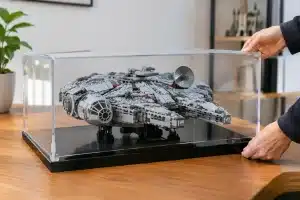
Set-specific acrylic display cases are especially effective in a modular collection because they establish clear boundaries. Each build receives a purpose-made home, protected from dust, accidental knocks and the constant temptation to move it when the shelf needs tidying.
Look for consistency in the details that will be visible across the room: clear acrylic panels, base finishes, case heights and the style of printed elements. A matching family of cases can unite a collection that includes wildly different subjects, from a sleek Formula 1 car to a medieval castle scene.
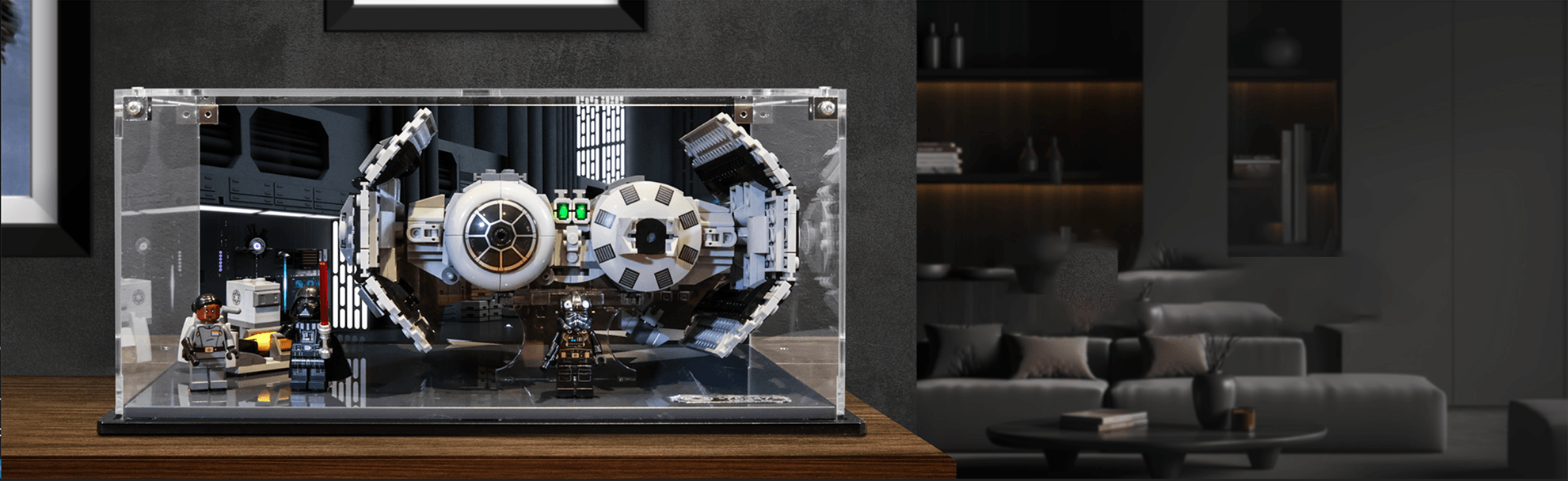
Printed bases and UV-printed backgrounds are where a display can move beyond storage. A well-chosen background gives a model context without asking you to build a permanent diorama around it. A dark starfield can make a spacecraft feel ready for launch; a workshop-inspired base gives a Technic car a suitably engineered setting; themed artwork can add atmosphere to a Disney or Harry Potter model without stealing attention from the bricks.
There is a trade-off. Highly themed artwork creates maximum impact for one particular set, while neutral black, white or clear presentation is easier to reuse if your collection changes direction. Neither option is automatically better. Choose themed prints for display pieces you know will remain favourites, and use a more flexible look for collections that are still taking shape.
At Brixbox, set-specific cases are designed around this collector mindset: the case should fit the build properly and elevate it, rather than make an exceptional model look like an item in generic storage.
Make shelf dimensions work harder
Modularity begins long before you place the first case. Measure the usable depth, width and height of each shelf, including any lip, cabinet door or awkward bracket. The dimensions printed on a shelving unit are not always the space your display actually has.
Depth is often the limiting factor. A deep model placed on a shallow shelf looks precarious, and a case that overhangs the edge loses the clean, gallery-like effect you are aiming for. Leave a small margin at the front and back, both for visual balance and for easier cleaning.
Height deserves the same care. Cases with room above the model make an impressive statement, but an overly tall case can waste valuable shelf space when you are planning several levels. On the other hand, packing models into narrow gaps makes even a premium collection look squeezed in. Aim for proportions that frame the set rather than merely contain it.
If you are using open shelving, decide whether every unit will align at the front edge or sit centrally. Front alignment looks crisp and architectural. Centred placement is more forgiving when case depths vary. Pick one approach per zone and repeat it.
Use layers to give the collection depth
A modular layout should not look flat. The simplest way to add depth is to place larger models at the rear or centre of a shelf, then use smaller supporting sets on stands or raised plinths where appropriate. This lets each build remain visible without creating a wall of overlapping silhouettes.
For minifigures, compact display cases are particularly useful. They can become a repeated collector’s grid beside the larger builds, turning characters into a proper feature rather than leaving them scattered at a model’s feet. The same principle works with BrickHeadz, helmets and smaller vehicles: repetition gives them presence.
Lighting can help, but restraint matters. A warm, even LED strip along the front or top of a shelf draws out printed details and makes clear acrylic edges disappear visually. Too many colour-changing lights, however, can compete with themed backdrops and make a carefully curated display feel more like a shop window. Let the model be the star.
Plan for access, cleaning and the next build
The best display looks brilliant on day one and remains enjoyable six months later. That means considering access before a shelf is full. Can you lift a case out without removing three other models? Can you reach the rear corner to dust the shelf? Is a delicate wing, antenna or cape protected from passing hands?
Dust protection is more than a cosmetic upgrade. Dust settles into studs, hinges and textured surfaces, and cleaning a detailed build can turn into a slow, nerve-racking job. A well-fitted acrylic case keeps the presentation sharper and reduces how often you need to handle the model itself.
Leave at least one planned expansion point in each major zone. It could be a spare shelf position, a space intended for a future matching case, or a small gap beside a flagship set. This removes the pressure to overhaul everything whenever a must-have release lands.
Let the collection tell a story
The most memorable modular LEGO displays do more than organise models. They show the collector’s taste. A shelf of Imperial ships can feel disciplined and imposing; a row of colourful Disney builds can bring warmth to a family space; a display of landmark vehicles can read like a personal museum of engineering and design.
Do not feel obliged to display every build you own. Rotating seasonal favourites, recent projects or smaller sets keeps the arrangement fresh and gives boxed or stored models their moment later on. Your display should celebrate the pieces that mean most to you, not become another task on the to-do list.
Start with one section, establish a format you genuinely enjoy looking at, then let it grow at the same pace as your collection. The next set deserves more than a spare patch of shelf – it deserves a place in the story.
RECENT POST